



Rate limiting is a traffic control mechanism that regulates the number of requests sent to or received from a network within a specified time period. This technique is essential for API management as it maintains service stability and performance by preventing excessive request volumes that could compromise system functionality. The primary function of rate limiting is to establish boundaries on request frequency per user or client within defined time intervals.
This prevents system overload and ensures consistent API availability across all users. Implementation of rate limiting protects against both intentional abuse and unintentional traffic spikes that could result in service degradation or complete system failure. Rate limiting provides several operational benefits for API infrastructure.
It prevents server overload by distributing request loads evenly, maintains optimal response times during peak usage periods, and ensures equitable resource allocation among users. The mechanism also serves as a defense against denial-of-service attacks and helps control operational costs by managing computational resource consumption. Different APIs employ various rate limiting strategies based on their architecture and user requirements.
Common approaches include fixed window limiting, sliding window algorithms, token bucket systems, and leaky bucket implementations. Each method offers distinct advantages for specific use cases, with selection typically depending on factors such as traffic patterns, user base size, and performance requirements.
Key Takeaways
- API rate limiting controls the number of requests to ensure fair usage and prevent overload.
- Selecting an appropriate rate limiting strategy depends on API usage patterns and business needs.
- Throttling techniques help manage traffic spikes and maintain API performance.
- Monitoring and analyzing API usage is essential for adjusting limits and improving user experience.
- Integrating rate limiting with API gateways enhances scalability and centralized control.
Choosing the Right Rate Limiting Strategy
Selecting an appropriate rate limiting strategy is crucial for the success of your API. There are several strategies available, each with its own advantages and disadvantages. For instance, you might consider using a fixed window approach, where you set a specific time frame during which a user can make a certain number of requests.
This method is straightforward and easy to implement but can lead to spikes in traffic at the beginning of each window. Alternatively, a sliding window approach offers more flexibility by allowing requests to be spread out over time, thus smoothing out traffic patterns. Another popular strategy is token bucket rate limiting, which allows for bursts of traffic while still enforcing an overall limit.
In this model, tokens are generated at a steady rate, and each request consumes a token. If the bucket is empty, the request is denied until more tokens are available. This method strikes a balance between flexibility and control, making it suitable for many applications.
As you evaluate these strategies, consider your API’s specific requirements and user behavior to determine which approach will best serve your needs.
Implementing Throttling Techniques

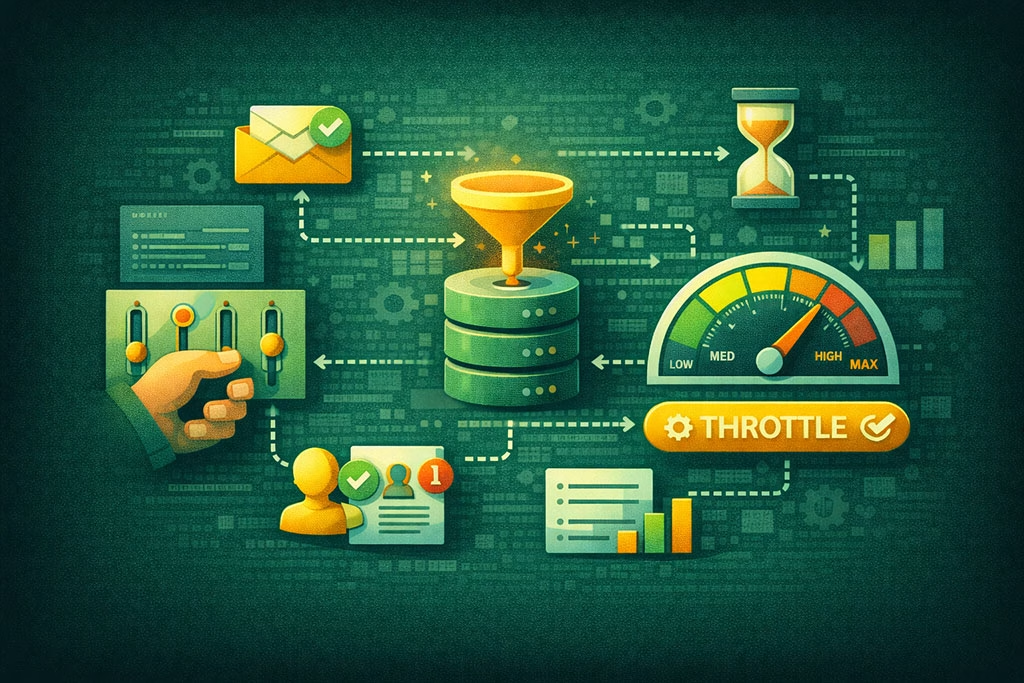
Once you’ve chosen a rate limiting strategy, the next step is implementing throttling techniques to enforce those limits effectively. Throttling refers to the process of controlling the flow of requests to your API based on the defined rate limits. This can be achieved through various methods, such as using middleware in your application or leveraging built-in features of your API management platform.
By integrating throttling into your API architecture, you can ensure that users adhere to the established limits while maintaining optimal performance.
One common technique for implementing throttling is to use response headers to inform users about their current usage status. For example, you might include headers that indicate how many requests remain in the current time window or when the limit will reset.
This transparency not only helps users understand their usage but also encourages them to stay within the defined limits. Additionally, consider implementing exponential backoff strategies for users who exceed their limits, allowing them to gradually increase their request rate after experiencing temporary denials.
Setting Rate Limits for Different API Endpoints
Not all API endpoints are created equal; some may require stricter rate limits than others based on their functionality and resource consumption. As you design your API, it’s essential to evaluate each endpoint’s purpose and set appropriate rate limits accordingly. For instance, endpoints that perform resource-intensive operations, such as data processing or complex queries, may warrant lower limits compared to those that serve lightweight data retrieval requests.
By tailoring rate limits for different endpoints, you can optimize resource allocation and enhance user experience. This approach allows you to prioritize critical functionalities while still providing access to less demanding features. Additionally, consider implementing tiered rate limits based on user roles or subscription levels.
For example, premium users might enjoy higher limits on certain endpoints, incentivizing them to upgrade while ensuring that free-tier users still have access to essential services.
Handling Burst Traffic
| Requests per Second (RPS) | Number of API requests sent per second | 1000 | High RPS can lead to throttling or rate limiting |
| Rate Limit Threshold | Maximum allowed requests in a given time window | 500 requests/minute | Exceeding this causes 429 Too Many Requests errors |
| Retry-After Duration | Time to wait before retrying after hitting rate limit | 60 seconds | Helps prevent app crashes by spacing out requests |
| Queue Length | Number of requests waiting to be sent | 200 | Long queues can increase latency but prevent overload |
| Success Rate | Percentage of requests successfully processed | 98% | High success rate indicates effective rate limiting |
| Error Rate (429) | Percentage of requests rejected due to rate limiting | 2% | Should be minimized to avoid user experience issues |
| Backoff Strategy | Method used to delay retries after rate limit errors | Exponential Backoff | Reduces request bursts and prevents app crashes |
In today’s digital landscape, burst traffic is a common challenge that many APIs face. Burst traffic refers to sudden spikes in request volume that can overwhelm your API if not managed properly. To effectively handle these surges, it’s crucial to implement strategies that allow your API to absorb increased loads without compromising performance or reliability.
One effective approach is to use queuing mechanisms that temporarily hold requests during peak times until they can be processed. Another technique for managing burst traffic is to leverage caching solutions. By caching frequently requested data, you can reduce the load on your backend systems during high-traffic periods.
This not only improves response times but also minimizes the risk of hitting rate limits for users who are trying to access popular resources. Additionally, consider implementing dynamic scaling solutions that automatically adjust your infrastructure based on real-time traffic patterns, ensuring that your API remains responsive even during unexpected surges.
Monitoring and Analyzing API Usage

To maintain an effective rate limiting strategy, continuous monitoring and analysis of API usage are essential. By tracking metrics such as request volume, response times, and error rates, you can gain valuable insights into how users interact with your API. This data will help you identify trends and patterns that may inform adjustments to your rate limiting rules or overall API design.
Utilizing analytics tools can streamline this process by providing real-time dashboards and reports on API performance. These tools can help you visualize usage patterns and detect anomalies that may indicate potential issues with your rate limiting strategy. Regularly reviewing this data will enable you to make informed decisions about optimizing your API’s performance and ensuring that it meets user needs effectively.
Handling Exceeding Rate Limits
When users exceed their allotted rate limits, it’s crucial to handle these situations gracefully to maintain a positive user experience. Instead of simply denying requests outright, consider providing informative error messages that explain why the request was denied and when the user can expect their limit to reset.
This transparency fosters understanding and encourages users to adjust their behavior accordingly.
Additionally, implementing a retry mechanism can help users recover from exceeding their limits without frustration. For instance, you might allow users to retry their requests after a certain cooldown period or provide them with an option to escalate their request if they believe they require additional access temporarily. By offering these alternatives, you can enhance user satisfaction while still enforcing necessary rate limits.
Customizing Rate Limiting Rules
Every API has unique requirements based on its user base and functionality; therefore, customizing rate limiting rules is essential for optimal performance. You may want to create different rules based on user roles or subscription tiers, allowing premium users more generous limits while maintaining stricter controls for free-tier users. This approach not only incentivizes upgrades but also ensures fair access across different user segments.
Moreover, consider implementing adaptive rate limiting that adjusts based on real-time usage patterns or system load. For example, during periods of high demand, you might temporarily lower limits for all users or specific endpoints to maintain overall system stability. Conversely, during low-traffic periods, you could relax limits slightly to encourage usage and engagement.
Customizing your rate limiting rules in this way allows you to respond dynamically to changing conditions while still protecting your API’s integrity.
Scaling Rate Limiting for High-Volume Sends
As your API grows in popularity and usage increases, scaling your rate limiting strategy becomes paramount. High-volume sends can strain your infrastructure if not managed properly; therefore, it’s essential to implement scalable solutions that can accommodate increased traffic without sacrificing performance. One effective approach is to distribute rate limiting across multiple servers or instances using load balancers.
By employing distributed rate limiting techniques, you can ensure that no single server becomes a bottleneck during peak traffic periods. Additionally, consider using cloud-based solutions that offer auto-scaling capabilities based on real-time demand. This flexibility allows your infrastructure to grow alongside your user base while maintaining consistent performance levels.
Integrating Rate Limiting with API Gateway
Integrating rate limiting with an API gateway can significantly enhance your ability to manage traffic effectively. An API gateway acts as a single entry point for all incoming requests and can enforce rate limits before they reach your backend services. This not only simplifies the implementation of rate limiting but also provides additional benefits such as authentication and logging.
When configuring your API gateway for rate limiting, ensure that it aligns with your overall strategy and business goals. You may want to set different limits based on user roles or specific endpoints directly within the gateway configuration. This centralized approach streamlines management and allows for easier adjustments as your API evolves over time.
Best Practices for API Rate Limiting
To ensure the effectiveness of your rate limiting strategy, adhering to best practices is essential. First and foremost, always communicate clearly with users about their rate limits through documentation and response headers. Transparency fosters trust and helps users understand how they can interact with your API without running into issues.
Additionally, regularly review and adjust your rate limits based on usage patterns and feedback from users. What works today may not be suitable tomorrow as your user base grows or changes in behavior occur. Finally, consider implementing fallback mechanisms for critical operations that may require higher limits during emergencies or special events.
By following these best practices, you can create a robust rate limiting strategy that enhances both performance and user satisfaction in your API ecosystem.
In the context of API rate limiting, it’s essential to consider how it impacts your email marketing strategies, especially when managing high-volume sends. For instance, the article on the power of a well-managed email list discusses the importance of maintaining a healthy subscriber base, which can directly influence your application’s performance during peak sending times. By understanding the relationship between your email list management and API rate limits, you can ensure that your app remains stable while effectively reaching your audience.
FAQs
What is API rate limiting?
API rate limiting is a technique used to control the number of API requests a client can make within a specified time frame. It helps prevent server overload and ensures fair usage among users.
Why is API rate limiting important?
Rate limiting protects your application and backend services from being overwhelmed by too many requests, which can cause crashes, slow performance, or downtime. It also helps maintain service availability and reliability.
How does API rate limiting work?
API rate limiting typically works by tracking the number of requests from a client (identified by IP address, API key, or user ID) and enforcing a maximum allowed number within a set period, such as 1000 requests per hour. Requests exceeding the limit are blocked or delayed.
What are common strategies for implementing rate limiting?
Common strategies include fixed window limiting, sliding window limiting, token bucket, and leaky bucket algorithms. Each method manages request flow differently to balance performance and fairness.
How can I handle rate limiting in my application?
Applications should detect rate limit responses from the API (usually HTTP status 429) and implement retry logic with exponential backoff or queue requests to avoid immediate failures.
Can rate limiting affect user experience?
Yes, if not managed properly, rate limiting can cause delays or errors for users. Proper handling, such as informing users about limits and retrying requests gracefully, helps minimize negative impacts.
Is rate limiting only for public APIs?
No, rate limiting is useful for both public and private APIs to protect backend resources and ensure consistent performance regardless of the client type.
What tools or services can help with API rate limiting?
Many API gateways, load balancers, and cloud providers offer built-in rate limiting features. Additionally, libraries and middleware exist for various programming languages to implement custom rate limiting.
How do I decide the appropriate rate limit for my API?
Determining rate limits depends on your server capacity, expected traffic, and business requirements. Monitoring usage patterns and scaling infrastructure accordingly helps set effective limits.
What happens if my application exceeds the API rate limit?
When the rate limit is exceeded, the API typically returns a 429 Too Many Requests response. Your application should handle this by pausing requests and retrying after the specified cooldown period.