



We’ve all heard the buzz about email marketing, and perhaps a small voice in the back of our heads has been nudging us to give it a try. For beginners, the sheer volume of information can be overwhelming. Where do we start? Which tools do we use? What are the best practices? Don’t worry, we’re here to guide you through the exciting world of email marketing, offering a grounded and practical approach to help your business flourish. We believe that with the right tools and techniques, anyone can master email marketing and reap its significant rewards.
Before we dive into the ‘how,’ let’s address the ‘why.’ Why should we, as busy business owners or aspiring marketers, dedicate our precious time and resources to email marketing? The answer is simple: because it works, and it works incredibly well.
Building Direct Relationships with Our Audience
Unlike social media, where algorithms dictate who sees our content, email marketing allows us to connect directly with our audience. When someone signs up for our email list, they’re essentially giving us permission to enter their inbox – a privilege we should never take lightly. This direct line of communication fosters trust and cultivates a deeper relationship, transforming casual browsers into loyal customers. We can personalize our messages, address their specific needs, and build a community around our brand.
Unparalleled Return on Investment (ROI)
Numerous studies consistently show that email marketing offers an astounding return on investment. For every dollar we spend, we can often see an average return of $42 or more. This is significantly higher than many other marketing channels. The low cost of sending emails, combined with the high conversion rates, makes email marketing an incredibly efficient way to generate leads, drive sales, and build brand loyalty. We’re essentially getting the most bang for our buck.
We Own Our Data
In a world increasingly dominated by third-party platforms, owning our customer data is paramount. With email marketing, we’re not reliant on the whims of social media algorithms or platform changes. Our email list is a valuable asset that we control completely. This gives us immense power and flexibility in how we communicate with our audience, ensuring our message always reaches them.
Driving Sales and Conversions
Ultimately, we’re all looking to grow our businesses, and email marketing is an incredibly powerful sales driver. We can use email to announce new products, offer exclusive discounts, promote valuable content, and nurture leads through the sales funnel. By segmenting our audience and tailoring our messages, we can guide them towards conversion with precision and effectiveness.
If you’re looking to enhance your understanding of email marketing beyond the basics, a great follow-up read is the article on unlocking the power of email marketing metrics. This resource provides valuable insights into real-time tracking and the key metrics that can help you optimize your campaigns. You can check it out here: Unlocking the Power of Email Marketing Metrics.
Essential Email Marketing Tools We Must Consider
Now that we understand the ‘why,’ let’s explore the ‘what’ – the tools that will empower us to execute our email marketing strategies effectively. For beginners, the sheer number of options can be overwhelming, so we’ll focus on user-friendly and feature-rich platforms.
Choosing Our Email Service Provider (ESP)
The foundation of our email marketing efforts is a reliable Email Service Provider (ESP). This is the platform we’ll use to manage our email lists, create our campaigns, and track our results.
Mailchimp: Our User-Friendly Starting Point
For many beginners, Mailchimp is the go-to choice, and for good reason. It offers a generous free plan for up to 2,000 contacts and 10,000 emails per month, making it perfect for those just starting out. Its intuitive drag-and-drop interface makes creating beautiful emails a breeze, even without any design experience. We can easily segment our audience, automate simple workflows, and access basic reporting to understand our campaign performance. We’ve found their tutorials and support resources to be excellent for newcomers.
Constant Contact: For Growing Businesses
As our business grows and our needs become more sophisticated, Constant Contact becomes an excellent option. While it doesn’t offer a free plan, its features are robust and user-friendly. We particularly appreciate their extensive template library, powerful list management tools, and event marketing integrations. Their customer support is also highly regarded, which is a huge plus when we’re facing technical challenges.
MailerLite: Our Simple Yet Powerful Alternative
MailerLite frequently comes up in discussions for its balance of simplicity and powerful features. It also offers a free plan for up to 1,000 subscribers, allowing us to send 12,000 emails per month. We love its clean interface, which makes it incredibly easy to navigate and build professional-looking emails. MailerLite also offers landing page builders and automation features, which are invaluable as we scale our efforts.
ActiveCampaign: For Advanced Automation Needs
While a bit more complex for absolute beginners, we mention ActiveCampaign because it’s a platform we’ll likely consider as our email marketing journey progresses. It excels in advanced automation, allowing us to create incredibly sophisticated customer journeys based on user behavior. If we’re planning extensive lead nurturing or complex sales funnels, ActiveCampaign is a tool we’ll want to explore once we’ve mastered the basics.
Building Our Email List: The Essential Tools
Without an email list, our ESP is simply a fancy email sender. We need effective ways to capture email addresses from our website visitors and social media followers.
Pop-up Forms: Engaging Our Website Visitors
Pop-up forms are a highly effective way to capture email addresses. Many ESPs offer built-in pop-up functionalities, or we can use dedicated tools like OptinMonster or Sumo. We’ve learned that timing and relevance are key here. A well-designed pop-up with a compelling offer that appears at the right moment can significantly boost our sign-up rates. We try to make them non-intrusive and offer real value.
Landing Page Builders: Our Dedicated Conversion Hubs
For specific campaigns or lead magnets, a dedicated landing page is invaluable. Tools like Leadpages or Unbounce allow us to create highly optimized landing pages that focus solely on capturing email addresses. These pages minimize distractions and clearly communicate the value proposition, increasing our chances of conversion. Our experience suggests that a clear call to action and a single focus are crucial for landing page success.
Embedded Forms: Seamless Integration on Our Site
Embedding a sign-up form directly into our website’s sidebar, footer, or blog posts is a less intrusive yet effective method. Our ESP will provide the necessary code to easily integrate these forms. We find that offering a “freebie” or a valuable resource in exchange for an email address significantly increases sign-ups here.
Our Winning Email Marketing Techniques: A Beginner’s Playbook

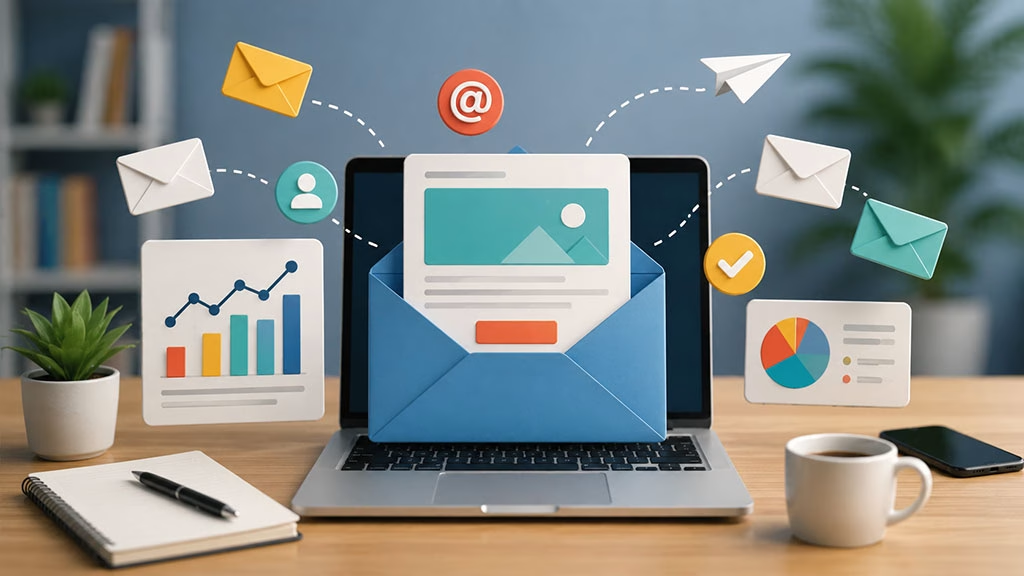
Once we have our tools in place, it’s time to put them to good use. These techniques are designed to help us build a strong foundation for our email marketing success.
Crafting Irresistible Subject Lines
The subject line is our first impression, our gateway to the inbox. If our subject line doesn’t grab attention, our email might never be opened.
Intriguing and Benefit-Driven Subject Lines
We always aim to be clear, concise, and compelling. Instead of “Newsletter Update,” we might try “Unlock 5 Secrets to Boost Your Productivity This Week.” We focus on the benefit to the reader rather than simply announcing content. We’ve also found that curiosity-inducing subject lines, without being click-baity, can work wonders.
Personalization Where Possible
If our ESP allows it, we incorporate the recipient’s first name into the subject line. This simple touch can significantly increase open rates, as it makes the email feel more personal and less like a mass communication.
Emojis and Numbers: When to Use Them
Judicious use of emojis and numbers can make our subject lines stand out in a crowded inbox. However, we’re careful not to overdo it, as too many emojis can sometimes make our email appear spammy. A single relevant emoji or a number highlighting a list or discount can be highly effective.
Designing Engaging Email Content
Once they open our email, we need to keep our readers engaged. Our content needs to be valuable, well-structured, and easy to consume.
Clear Call-to-Actions (CTAs)
Every email we send should have a clear purpose and a single, prominent call to action. Whether it’s “Shop Now,” “Read More,” or “Download Your Free Guide,” our CTA should be easy to find and understand. We use contrasting colors and button formats to make them stand out.
Visual Appeal and Branding Consistency
We use our brand colors, fonts, and logo consistently throughout our emails to reinforce our brand identity. High-quality images and videos can break up text and make our emails more visually appealing. However, we’re mindful of email load times and avoid excessively large files.
Valuable Content: Educate, Entertain, or Offer Value
Our emails should always provide value to our subscribers. This could be in the form of educational content, entertaining stories, exclusive discounts, or helpful tips. We avoid being overly promotional in every email; a good balance of value-driven content and promotional messages is key.
Building and Segmenting Our Email List
A large email list is good, but a segmented, engaged email list is gold. We always strive to understand our audience and group them based on their interests and behaviors.
Offering Irresistible Lead Magnets
To entice people to sign up for our list, we offer something valuable in return – a “lead magnet.” This could be a free e-book, a checklist, a webinar recording, an exclusive discount, or a mini-course. The key is that it’s highly relevant to our target audience and solves a specific problem for them.
Segmenting Based on Interests and Behavior
We don’t send the same email to everyone. We segment our list based on demographics, purchase history, website activity, or even how they signed up. For example, customers who purchased a specific product might receive different emails than new subscribers who haven’t made a purchase yet. This allows us to send highly targeted and relevant messages, increasing engagement and conversion rates. We’ve seen a significant uplift in our metrics when we’ve properly segmented our lists.
Maintaining List Hygiene: Cleaning Out Inactive Subscribers
Periodically, we “clean” our email list by removing inactive subscribers. These are people who haven’t opened or clicked our emails in a long time. Keeping them on our list can hurt our sender reputation and lower our overall engagement rates. We try sending a “we miss you” email first and if there’s still no engagement, we consider removing them.
Automating Our Email Journeys
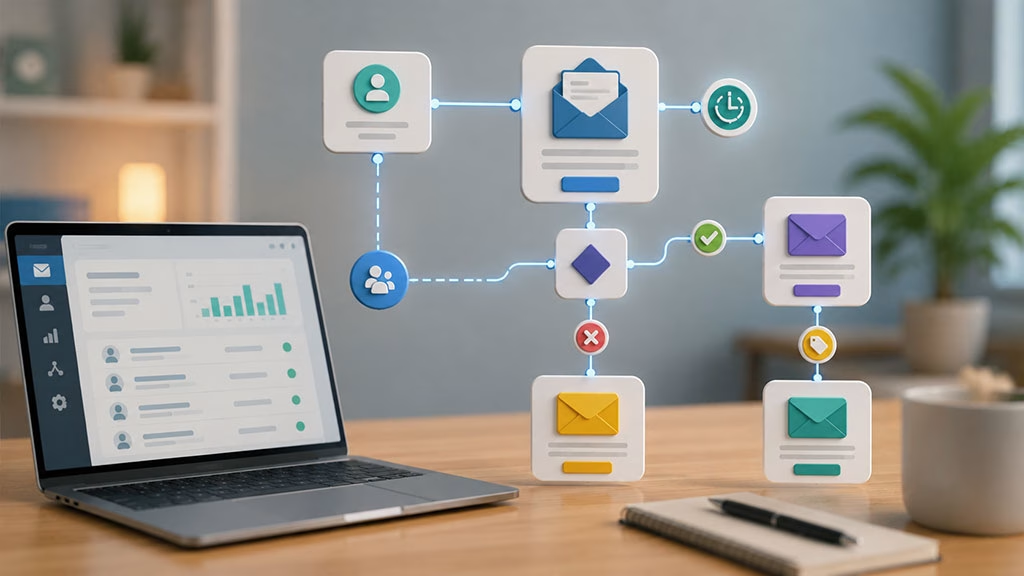
Email automation is where we truly leverage the power of our ESP. It allows us to set up sequences of emails that are triggered by specific actions or events, nurturing our leads and customers on autopilot.
Welcome Sequences: Our First Impression
A welcome sequence is arguably the most important automation we’ll set up. It’s the first interaction a new subscriber has with our brand after opting in.
Setting Expectations and Delivering Value
Our welcome sequence should immediately deliver on the promise of our lead magnet, introduce our brand, set expectations for future emails, and highlight our unique selling proposition. We typically send 2-3 emails in this sequence over a few days, ensuring a warm and informative introduction.
Nurturing New Leads
Beyond the initial welcome, we use automation to nurture new leads. This could involve a series of educational emails that help them understand our products or services better, address common pain points, and build trust. We’re guiding them gently towards a purchase decision.
Abandoned Cart Reminders: Recovering Lost Sales
For e-commerce businesses, abandoned cart emails are a goldmine. When a customer adds items to their cart but leaves without purchasing, an automated email can gently remind them of their uncompleted order.
Offering Incentives (Optional)
We’ve found that sometimes a small incentive, like a discount code or free shipping, can be the push a customer needs to complete their purchase. However, we use this judiciously to avoid conditioning customers to expect discounts. Our initial reminder is often without an incentive, saving the discount for a subsequent email if they still haven’t converted.
Re-engaging Inactive Subscribers
As mentioned earlier, automation can also help us re-engage inactive subscribers. We can set up a specific sequence to reach out to those who haven’t opened our emails in a while, perhaps offering something compelling to draw them back in before we consider removing them from our list.
If you’re looking to enhance your email marketing strategy, you might find it beneficial to explore advanced techniques that can elevate your campaigns. A great resource for this is an article on mastering advanced personalization with Spintags, which can help you avoid sounding robotic in your communications. You can read more about it in this insightful piece on advanced personalization. This approach complements the foundational tools and techniques outlined in the Beginner Guide to Email Marketing Tools and Techniques, allowing you to create more engaging and personalized content for your audience.
Measuring Our Success and Iterating
| Tool | Features | Price |
|---|---|---|
| Mailchimp | Email templates, A/B testing, analytics | Free for up to 2,000 contacts |
| Constant Contact | Email automation, contact management, reporting | Starting at 20/month |
| SendinBlue | Transactional emails, marketing automation, SMS marketing | Free for up to 300 emails per day |
| GetResponse | Landing pages, webinars, autoresponders | Starting at 15/month |
Email marketing isn’t a “set it and forget it” strategy. To continuously improve, we absolutely must track our performance and be willing to adjust our approach based on the data.
Key Metrics We Must Track
Our ESP will provide us with a wealth of data. We focus on these core metrics to understand how our campaigns are performing.
Open Rate: How Many People Saw Our Subject Line’s Appeal
The open rate tells us the percentage of recipients who opened our email. A low open rate often indicates a problem with our subject line, sender name, or the perceived value of our emails. We constantly experiment with different subject lines to improve this metric.
Click-Through Rate (CTR): Our Content’s Engagement Power
The click-through rate measures the percentage of people who clicked on a link within our email. A low CTR might suggest that our content isn’t compelling, our call to action isn’t clear, or the offer isn’t relevant to our audience. This is where segmenting really shines, allowing us to tailor content to specific interests.
Conversion Rate: The Ultimate Goal
The conversion rate is the percentage of people who completed our desired action (e.g., made a purchase, downloaded a guide) after clicking through from our email. This is the ultimate measure of our email campaign’s effectiveness in driving business goals.
Bounce Rate: Keeping Our List Healthy
The bounce rate indicates the percentage of emails that couldn’t be delivered to the recipient’s inbox. We keep an eye on two types: hard bounces (permanent delivery failures) and soft bounces (temporary issues). High bounce rates can harm our sender reputation, so we regularly clean our list.
Unsubscribe Rate: A Sign of What We Could Improve
While it’s natural to have some unsubscribes, a consistently high unsubscribe rate signals that our content might not be relevant, our sending frequency is too high, or our emails aren’t meeting subscriber expectations. We view every unsubscribe as an opportunity to learn and improve.
A/B Testing: Our Scientific Approach to Improvement
A/B testing, also known as split testing, is a powerful technique that allows us to test different versions of our emails to see which performs better.
Testing Subject Lines and CTAs
We can A/B test almost any element of our email, but we often start with subject lines and calls to action. By sending two different versions to a small segment of our audience and then sending the winner to the rest, we can optimize our campaigns for maximum engagement.
Optimizing Email Content and Send Times
Beyond subject lines and CTAs, we can experiment with different email layouts, image choices, content lengths, and even the time and day we send our emails. We approach A/B testing systematically, changing one variable at a time to accurately pinpoint what’s working and what isn’t.
Email marketing might seem daunting at first, but with the right tools, a clear understanding of fundamental techniques, and a commitment to continuous improvement, we can transform it into one of our most powerful marketing assets. We encourage you to start small, experiment, learn from your results, and enjoy the process of building meaningful connections with your audience. The journey is incredibly rewarding, and we’re excited to see the success you achieve!
FAQs
What are email marketing tools?
Email marketing tools are software or platforms that help businesses create, send, and track email marketing campaigns. These tools often include features such as email templates, contact management, automation, and analytics to help businesses effectively reach and engage their target audience through email.
What are some popular email marketing tools?
Some popular email marketing tools include Mailchimp, Constant Contact, AWeber, GetResponse, and Campaign Monitor. These tools offer a range of features and pricing options to suit the needs of different businesses, from small startups to large enterprises.
What are some common email marketing techniques?
Common email marketing techniques include personalized email content, segmentation of email lists based on customer behavior or demographics, A/B testing of subject lines and content, automation of email campaigns, and monitoring of key metrics such as open rates, click-through rates, and conversion rates.
How can businesses benefit from using email marketing tools?
Businesses can benefit from using email marketing tools by reaching a wider audience, nurturing leads, building customer relationships, driving sales, and increasing brand awareness. These tools also provide valuable insights into customer behavior and campaign performance, which can inform future marketing strategies.
What should beginners consider when choosing an email marketing tool?
Beginners should consider factors such as ease of use, pricing, available features, customer support, integration with other marketing tools or platforms, and scalability when choosing an email marketing tool. It’s important to select a tool that aligns with the business’s goals and resources.