


The Shifting Tides of Marketing Measurement
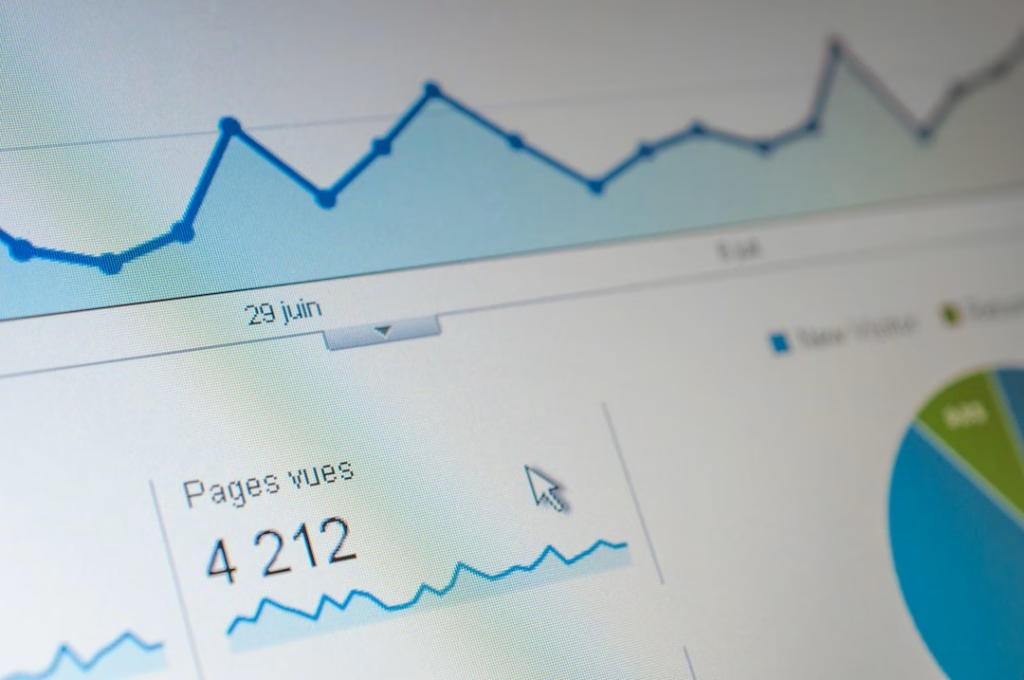
You’ve probably noticed a seismic shift in the marketing landscape. What was once a world of quarterly reports and weekly data dumps is rapidly evolving into an always-on, instantaneous environment. This isn’t just a trend; it’s a fundamental change in how marketing operates and, more critically, how you measure its effectiveness. You’re no longer content to wait for yesterday’s news; you demand today’s insights, right now. This demand for immediacy is precisely why real-time reporting is transforming from a luxury into a marketing technology standard. The sheer volume of data, the speed at which campaigns can be launched and iterated, and the fierce competition for customer attention all conspire to make historical data increasingly insufficient for agile decision-making. You need to understand performance as it happens, not after the fact, to effectively steer your marketing efforts and maximize your return on investment. The days of making strategic decisions based on information that’s already several days or weeks old are quickly fading into obsolescence. Your competitors, if they’re smart, are already leveraging real-time data to gain an advantage.
The Problem with Lagging Indicators
Think back to a time when you relied solely on end-of-month reports. You’d see the results, perhaps a dip in conversions or a surge in traffic, but the “why” often remained elusive. By the time you analyzed the data, formulated a hypothesis, and planned a course correction, weeks might have passed. The opportunity to capitalize on a sudden trend or mitigate a negative impact in its infancy was lost. Lagging indicators, while still valuable for long-term strategic analysis, simply don’t provide the agility required in today’s fast-paced digital environment. You’re left reacting to events that have already unfolded, rather than proactively shaping them. This reactive stance can lead to wasted budget, missed opportunities, and ultimately, a less effective marketing strategy.
The Need for Instantaneous Feedback Loops
Imagine launching a new ad campaign. In a traditional reporting model, you might wait days to see initial performance metrics. During that time, your budget is being spent, and if the campaign isn’t resonating, you’re essentially throwing money away. With real-time reporting, you see the clicks, the impressions, the conversions, and even the sentiment almost immediately. This instantaneous feedback loop allows you to identify underperforming creative, adjust targeting, or even pause a campaign before significant resources are expended. It empowers you to iterate and optimize on the fly, transforming your marketing from a series of educated guesses into a continuous process of data-driven refinement.
As businesses increasingly recognize the importance of real-time reporting in their marketing strategies, it is essential to explore how other technological advancements complement this trend. A related article that delves into the significance of speed in digital marketing is titled “Speed Kills: Lightning-Fast Landing Pages in Smartmails.” This piece highlights the critical role that fast-loading landing pages play in enhancing user experience and conversion rates, further emphasizing the need for timely data insights. For more information, you can read the article here: Speed Kills: Lightning-Fast Landing Pages in Smartmails.
Empowering Agile Marketing and Optimization
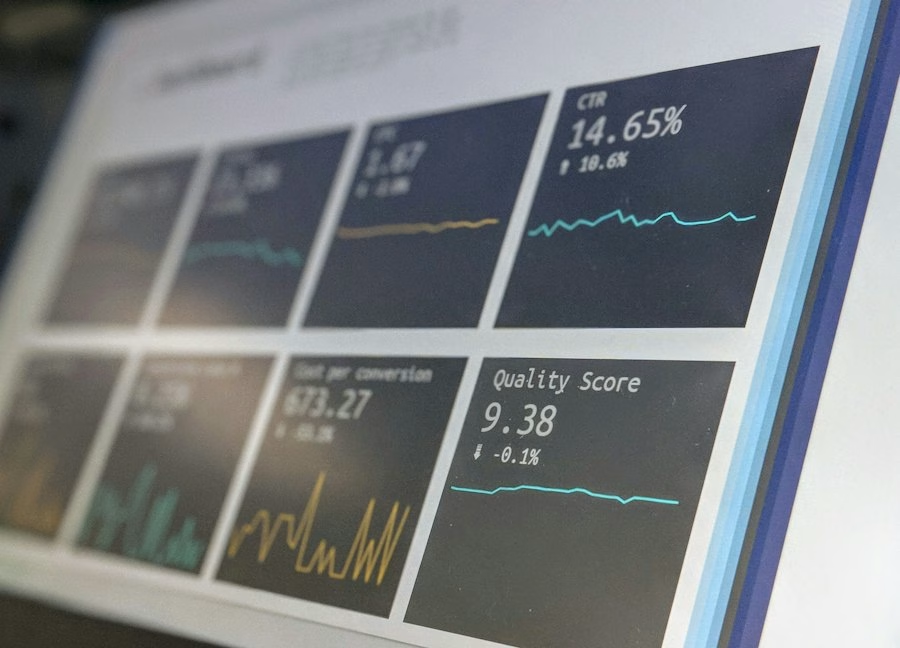

Real-time reporting isn’t just about faster data; it’s about enabling a fundamentally different way of working. It underpins an agile marketing methodology, where continuous improvement and rapid iteration are paramount. You’re no longer constrained by the limitations of delayed information, allowing you to react to the market as it moves, not after it’s settled. This agility is a key differentiator in a crowded digital landscape where customer preferences can shift in an instant and new competitors emerge regularly.
On-the-Fly Campaign Adjustments
Consider a scenario where you’re running multiple A/B tests on your landing page. With real-time data, you can quickly identify which variation is performing best and allocate more budget or traffic to that winner, even within the same day. This immediate insight prevents you from wasting valuable resources on underperforming elements. You can tweak headlines, calls to action, image choices, and even entire page layouts with confidence, knowing you’ll see the impact almost instantly. This continuous optimization cycle allows you to maximize the effectiveness of every dollar spent and every impression served. Without real-time insights, you’re essentially flying blind, making changes based on intuition rather than concrete evidence, and potentially missing out on significant performance gains.
Real-Time Budget Allocation and Spend Efficiency
One of the most critical advantages real-time reporting offers is the ability to optimize your budget allocation in the moment. If you see a particular channel or campaign significantly outperforming others, you can instantly shift budget towards it to capitalize on the momentum. Conversely, if a campaign is underperforming, you can reduce its spend or reallocate those funds to more effective initiatives before they are completely wasted. This dynamic budget management ensures that your marketing spend is always working as hard as possible for you. You’re not waiting for weekly or monthly reports to discover inefficiencies; you’re addressing them proactively, ensuring maximum ROI from your marketing investments. This level of granular control over your spending is simply not possible with delayed data.
Identifying and Capitalizing on Emerging Trends
The digital world is a constant flurry of new trends, viral content, and changing consumer behaviors. Real-time reporting equips you to spot these shifts as they happen. Imagine a sudden surge in interest for a particular product category or a trending topic relevant to your brand. With real-time analytics, you can identify this uptick immediately and launch targeted campaigns or create relevant content to capitalize on the momentum before your competitors even realize what’s happening. This ability to be first to market or first to respond to a cultural moment can provide a significant competitive advantage and drive substantial engagement. You become a trendsetter, not a follower, by reacting instantaneously to the evolving digital landscape.
Enhanced Customer Understanding and Personalization


Beyond campaign optimization, real-time reporting significantly deepens your understanding of your customers. Every click, every interaction, every purchase or abandonment provides a data point that, when analyzed in real-time, paints a vivid picture of their journey and preferences. This immediate insight is crucial for delivering the personalized experiences that today’s consumers demand. You’re not just guessing what your customers want; you’re seeing it unfold before your eyes. This richer, more immediate understanding fosters stronger customer relationships and drives greater loyalty.
Personalized Experiences at Scale
With real-time data flowing in, you can personalize the customer experience on the fly. If a user is browsing a specific product category on your website, you can dynamically display related products, offer personalized discounts, or even trigger a real-time chat with a sales representative. This level of immediate, relevant interaction significantly improves the customer journey and increases conversion rates. You’re not treating every customer the same; you’re responding to their individual needs and interests in the moment they express them. This personalized approach fosters a sense of being understood and valued, which is paramount in today’s competitive market.
Real-Time Customer Journey Mapping
Real-time reporting allows you to visualize and understand the customer journey as it’s happening. You can see precisely where users are engaging, where they’re dropping off, and what paths they’re taking to conversion. This granular view enables you to identify bottlenecks, optimize touchpoints, and smooth out any friction points in the customer experience in real-time. By continuously monitoring and refining the journey, you can guide customers more effectively towards their desired outcomes, leading to higher satisfaction and improved business results. This dynamic understanding of the customer journey is far more powerful than static, retrospective analyses.
Proactive Customer Service Interventions
Imagine a customer encountering an issue with your website or a problem during the checkout process. With real-time reporting, you can identify these struggles almost instantly. This allows your customer service team to proactively reach out, offer assistance, or provide solutions before the customer becomes frustrated enough to abandon their purchase or seek assistance elsewhere. This proactive approach to customer service not only resolves issues faster but also demonstrates a high level of attentiveness and care, significantly improving customer loyalty and brand perception. You’re not waiting for them to complain; you’re anticipating their needs.
The Technological Backbone of Real-Time Reporting
Achieving true real-time reporting isn’t as simple as flicking a switch. It requires a robust technological infrastructure capable of ingesting, processing, and presenting vast amounts of data with minimal latency. You need to invest in the right tools and systems to make this a reality, understanding that the benefits far outweigh the initial investment. The era of manual data aggregation and spreadsheet analysis for real-time insights is long gone; automation and sophisticated platforms are now essential.
Data Integration and API Connectivity
The foundation of real-time reporting lies in seamless data integration. Your marketing technology stack is likely comprised of numerous platforms – your CRM, your analytics platform, your ad platforms, your email service provider, and more. For real-time reporting to be effective, all of these systems must be able to communicate and share data instantaneously. This often involves robust API (Application Programming Interface) connectivity, allowing different software applications to talk to each other and exchange information in a structured, automated way. Without proper integration, you’re left with siloed data, making a unified, real-time view impossible.
Powerful Analytics and Visualization Platforms
Once the data is flowing, you need powerful analytics platforms that can process and interpret it at lightning speed. These platforms go beyond basic dashboards, offering advanced analytics capabilities like machine learning for anomaly detection, predictive modeling, and sophisticated segmentation. Crucially, they must also provide intuitive and customizable visualization tools. You need to be able to see the data in a clear, digestible format – charts, graphs, heatmaps – that allows for quick interpretation and actionable insights without requiring extensive data science expertise. The goal is to make complex data understandable at a glance.
Cloud-Based Infrastructure and Scalability
The sheer volume and velocity of data generated by modern marketing activities demand a scalable infrastructure. Cloud-based solutions are typically ideal for real-time reporting because they offer unparalleled flexibility and scalability. As your data needs grow, cloud platforms can seamlessly expand to accommodate them without requiring significant upfront hardware investments or complex IT management. This ensures that your real-time reporting capabilities can keep pace with your marketing efforts, no matter how rapidly they evolve. You can spin up new resources as needed and scale back during quieter periods, optimizing your operational costs.
As businesses increasingly recognize the importance of timely data, the shift towards real-time reporting in marketing technology is becoming a standard practice. This evolution not only enhances decision-making but also allows for more agile responses to market changes. For those interested in further exploring how data-driven strategies can optimize marketing efforts, a related article discusses the benefits of retargeting pixels in maximizing conversions. You can read more about it in this insightful piece on maximizing conversions with retargeting pixels.
The Future: Predictive Analytics and Prescriptive Actions
| Metric | Description | Impact on Marketing | Example |
|---|---|---|---|
| Data Latency | Time delay between data generation and reporting | Real-time reporting reduces latency from hours/days to seconds/minutes, enabling faster decision-making | Campaign adjustments made within minutes based on live user engagement |
| Customer Engagement Rate | Percentage of users interacting with marketing content | Real-time insights allow marketers to optimize content instantly, increasing engagement rates by up to 20% | Live A/B testing of ad creatives to boost click-through rates |
| Conversion Rate Optimization | Improvement in percentage of visitors completing desired actions | Immediate feedback on campaign performance helps increase conversion rates by identifying and fixing issues quickly | Adjusting landing page elements based on real-time user behavior |
| Marketing ROI Visibility | Ability to track return on investment in near real-time | Enables budget reallocation to high-performing channels promptly, improving overall ROI | Shifting spend from underperforming ads to top-performing ones within the same day |
| Customer Experience Personalization | Customization of marketing messages based on live data | Real-time data allows dynamic personalization, increasing relevance and customer satisfaction | Serving personalized offers based on current browsing behavior |
While real-time reporting focuses on what’s happening now, its true power lies in its ability to lay the groundwork for what’s next. By continuously feeding vast amounts of current data into intelligent systems, you’re moving beyond merely understanding the present to anticipating the future and, even more powerfully, influencing it. You’re transitioning from being reactive to truly proactive, leveraging data to not only explain past events but to predict future outcomes and recommend optimal actions.
Moving Beyond Descriptive to Predictive
Real-time reporting is primarily descriptive – it tells you what is currently happening. However, by continually feeding this live data into advanced analytics models, you can move into the realm of predictive analytics. Imagine not just seeing a drop in conversion rates but being alerted to an imminent drop based on current user behavior trends. Predictive models, powered by real-time data, can forecast future performance, identify potential risks, and highlight emerging opportunities before they fully materialize. This allows you to prepare and adapt your strategies ahead of time, rather than reacting after the fact. You’re no longer just reporting on history; you’re forecasting the future with increasing accuracy.
Enabling Prescriptive Marketing Actions
The ultimate evolution of real-time reporting is its integration with prescriptive analytics. This goes a step beyond prediction by not only forecasting what will happen but also recommending the best course of action to achieve a desired outcome or mitigate an undesirable one. For example, if a predictive model suggests a specific ad campaign will underperform in certain demographics, a prescriptive system might automatically suggest adjustments to targeting, creative, or bidding strategies – all in real time. This moves you towards an automated, intelligent marketing ecosystem where decisions are not just data-driven but data-dictated, freeing up your team to focus on higher-level strategy and innovation. You’re not just getting insights; you’re getting actionable recommendations delivered automatically.
AI and Machine Learning Integration
Artificial intelligence (AI) and machine learning (ML) are the engines driving the predictive and prescriptive capabilities of real-time reporting. ML algorithms can identify subtle patterns and correlations in vast datasets that would be impossible for human analysis. They can learn from continuous streams of real-time data, constantly refining their predictions and recommendations. From dynamic content optimization to personalized journey orchestration, AI and ML, fueled by real-time insights, are poised to automate and optimize increasingly complex marketing decisions, pushing the boundaries of what’s possible in marketing effectiveness. You’re moving towards a marketing operation that can learn and adapt independently, becoming smarter with every new piece of data.
FAQs
What is real-time reporting in marketing technology?
Real-time reporting in marketing technology refers to the ability to track and analyze data as it happens, providing instant insights into campaign performance, customer behavior, and other key metrics.
Why is real-time reporting becoming a standard in marketing technology?
Real-time reporting is becoming a standard in marketing technology because it allows marketers to make data-driven decisions quickly, optimize campaigns in real-time, and respond promptly to changing market conditions.
What are the benefits of using real-time reporting in marketing technology?
The benefits of using real-time reporting in marketing technology include improved decision-making, faster campaign optimization, better targeting of audiences, increased ROI, and the ability to stay ahead of competitors.
How does real-time reporting impact marketing strategies?
Real-time reporting impacts marketing strategies by enabling marketers to adapt their tactics based on up-to-the-minute data, identify trends early, personalize messaging in real-time, and allocate resources more effectively for maximum impact.
What are some common tools and platforms used for real-time reporting in marketing technology?
Common tools and platforms used for real-time reporting in marketing technology include Google Analytics, Adobe Analytics, HubSpot, Salesforce, and various marketing automation software that offer real-time analytics and reporting capabilities.