



You are likely looking for ways to optimize your customer acquisition cost (CAC) without sacrificing growth. One highly effective strategy is the automation of onboarding sequences. This process, when implemented correctly, can act as a powerful lever, streamlining your customer journey from initial interaction to becoming a paying user. By automating key touchpoints, you can reduce the manual effort involved, improve efficiency, and ultimately drive down the cost associated with acquiring each new customer.
To begin, consider your current onboarding process. Is it a well-oiled machine, or are there points where manual intervention creates bottlenecks and incurs unnecessary expense? Automated onboarding sequences are not simply about sending automated emails; they are a strategic approach to guiding new users through the initial stages of your product or service. This involves a series of pre-programmed interactions designed to educate, engage, and convert users, minimizing the need for direct human intervention at every step. Think of it as building an efficient factory for customer success, where each stage of production is handled with precision and minimal waste.
Understanding Customer Acquisition Cost (CAC)
Before diving into automation, it’s crucial to grasp what CAC represents. Your CAC is the total cost of sales and marketing efforts required to acquire a new customer. This includes everything from advertising spend and content creation to the salaries of your sales and marketing teams, and the tools they use. A high CAC means you are spending a significant amount of money to bring each customer into your fold. The goal of automation, particularly in onboarding, is to shrink this figure considerably, allowing you to allocate your resources more effectively and achieve greater profitability.
The Bottlenecks of Manual Onboarding
Manual onboarding, while personal, is often slow and resource-intensive. Imagine a customer signing up for your service. If they require a lengthy phone call, a personalized demonstration for every single feature, and individual follow-ups at each stage, the cost associated with that one customer balloons. This can include:
- Sales Representative Time: Every hour a sales rep spends guiding a new user is an hour they are not prospecting for new leads or closing other deals.
- Customer Support Strain: A high volume of basic onboarding questions can overwhelm your support team, diverting them from more complex issues.
- Inconsistent Experience: Manual processes are prone to human error and can lead to a less than uniform experience for each customer, impacting retention.
- Scalability Issues: As your business grows, your manual onboarding process will struggle to keep pace, leading to longer wait times and frustrated new users.
The Promise of Automation: Efficiency and Scalability
Automation offers a solution to these challenges. By pre-defining and automating repetitive tasks within the onboarding sequence, you free up valuable human capital. This allows your sales team to focus on high-value prospects and complex sales, while your support team can tackle more intricate customer issues. Furthermore, automated systems are inherently scalable. As your customer base grows, your automated sequences can handle the influx without a proportional increase in costs.
Identifying Key Automation Opportunities
Within your onboarding flow, there are several critical junctures where automation can make a significant impact. These often include:
- Initial Welcome and Setup: Automating the welcome email, providing immediate access to essential resources, and guiding users through the very first steps of setting up their account.
- Feature Discovery and Adoption: Using automated product tours, in-app messaging, and triggered emails to introduce users to key features, encouraging adoption and demonstrating value.
- Progressive Engagement: Tailoring the onboarding sequence based on user behavior, providing more in-depth guidance for those who are struggling and accelerating the process for those who are quickly grasping the concepts.
In the quest to reduce Customer Acquisition Costs (CAC), automating onboarding sequences can play a pivotal role in streamlining the customer journey and enhancing engagement. A related article that delves into optimizing lead management is titled “The Sunset Policy: How to Automatically Suppress Inactive Leads to Save Deliverability.” This piece discusses strategies for managing inactive leads effectively, which can complement efforts to automate onboarding and ultimately lead to a more efficient acquisition process. You can read the article here: The Sunset Policy: How to Automatically Suppress Inactive Leads to Save Deliverability.
Post-Demo Automation: Seizing the Momentum
The period immediately following a product demonstration is a crucial window of opportunity. This is when a potential customer’s interest is at its peak, and they have a clear understanding of your offering. Failing to capitalize on this momentum can lead to lost conversions and wasted sales efforts. Post-demo automation is designed to bridge this gap, ensuring that interest translates into action.
The Power of Instant Follow-Ups
Research indicates that post-demo automation can dramatically reduce CAC. By implementing immediate, relevant follow-up sequences, you can shorten sales cycles and significantly boost conversion rates. For example, some solutions have reported reductions in CAC by as much as 71% and a 50% shortening of sales cycles, coupled with a 40% increase in conversions. This is achieved by providing instant access to relevant information, personalized next steps, and scheduled follow-up communications, all without manual intervention. Think of it as striking while the iron is hot; the sooner you engage after a demo, the more likely you are to secure the customer.
Delivering Value Beyond the Demo
Your post-demo automation shouldn’t just be a reminder; it should continue to deliver value. This can include:
- On-demand access to demo recordings: Allowing customers to revisit key points at their convenience.
- Personalized resource libraries: Curating content based on the specific needs and interests expressed during the demo.
- Clear calls to action: Guiding the customer towards the next logical step, whether it’s a trial, a proposal review, or scheduling a follow-up call.
Shortening the Sales Cycle
By automating these critical post-demo steps, you eliminate the delays often associated with manual follow-ups. This rapid engagement keeps your product top-of-mind and prevents potential customers from drifting away or being swayed by competitors. A shorter sales cycle not only reduces the overall cost of sales but also allows your sales team to engage with more prospects within the same timeframe, further optimizing resource allocation.
Case Study: CloudSync Solutions’ Transformation
Consider the documented success of companies like CloudSync Solutions. In 2025, they reduced their CAC from $847 to $244 by implementing robust post-demo automation. This transformation highlights the tangible financial benefits that strategic automation can bring. It demonstrates that by investing in automated follow-up systems, businesses can achieve substantial cost savings while simultaneously improving their sales performance.
SaaS Onboarding Sequences: Guiding Users to Value

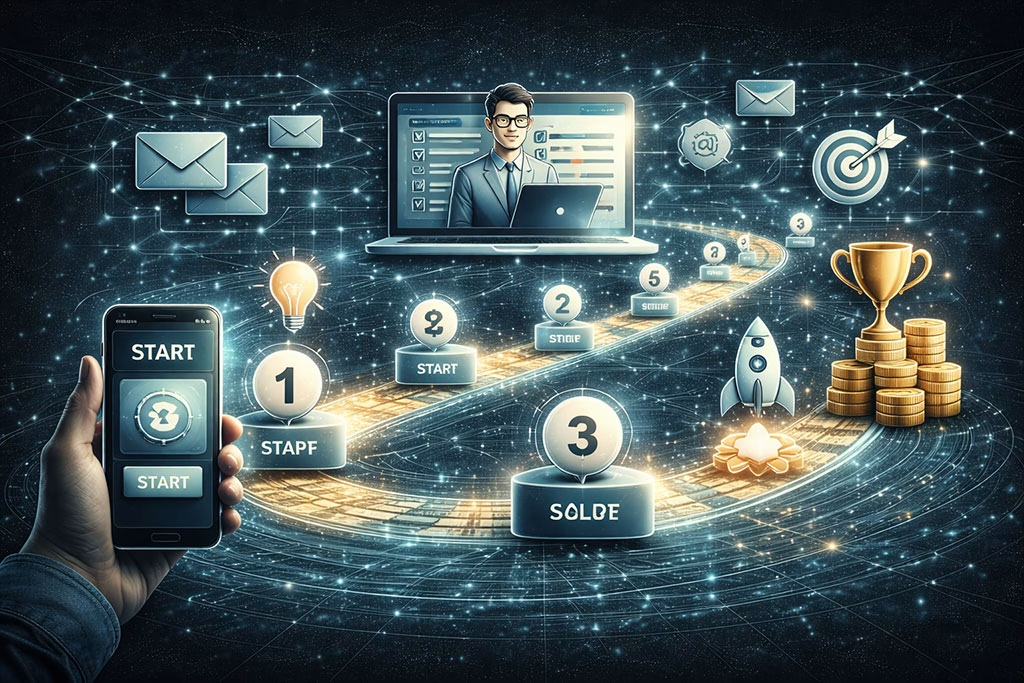
For Software as a Service (SaaS) businesses, the onboarding process is particularly critical. You are not just selling a product; you are selling a solution that needs to be integrated into a user’s workflow. Effective onboarding sequences ensure that users quickly understand and harness the full capabilities of your software, leading to sustained engagement and reduced churn.
Improving Trial-to-Paid Conversions
Automated onboarding sequences are instrumental in moving users from a free trial to a paid subscription. Studies show that these sequences can improve trial-to-paid conversions by as much as 40%. This is achieved by systematically demonstrating the value proposition of your product. By guiding users through key features and highlighting how your software solves their specific problems, you build confidence and create a desire to continue using the service.
Boosting Free Trial Engagement
Beyond conversions, automated onboarding also plays a vital role in increasing the engagement rates of free trial users. By providing clear instructions and encouraging interaction with core functionalities, you ensure that trial users are actively exploring your product. This can lead to a 25-50% increase in free trial engagement. A more engaged trial user is a more likely eventual paying customer, as they have experienced the benefits firsthand.
Automated Product Tours and Feature Adoption
One of the most effective automated onboarding tools is the product tour. These interactive guides, often embedded within the application itself, walk users through essential features step-by-step. Automated product tours have been shown to increase feature adoption by an impressive 35%. This means users are not just signing up; they are actively discovering and utilizing the functionalities that provide them with the most value, thereby increasing their stickiness and reducing the likelihood of them churning.
The Metaphor of a Guided Expedition
Think of your SaaS product as a vast, uncharted territory. Without a map and a guide, new explorers might get lost, miss out on valuable discoveries, or even abandon their quest altogether. Your automated onboarding sequence is that map and guide. It highlights the most important landmarks (features), points out the fastest routes to success (workflows), and ensures that the explorers have the tools they need to navigate and thrive.
Personalized Onboarding: Tailoring the Journey
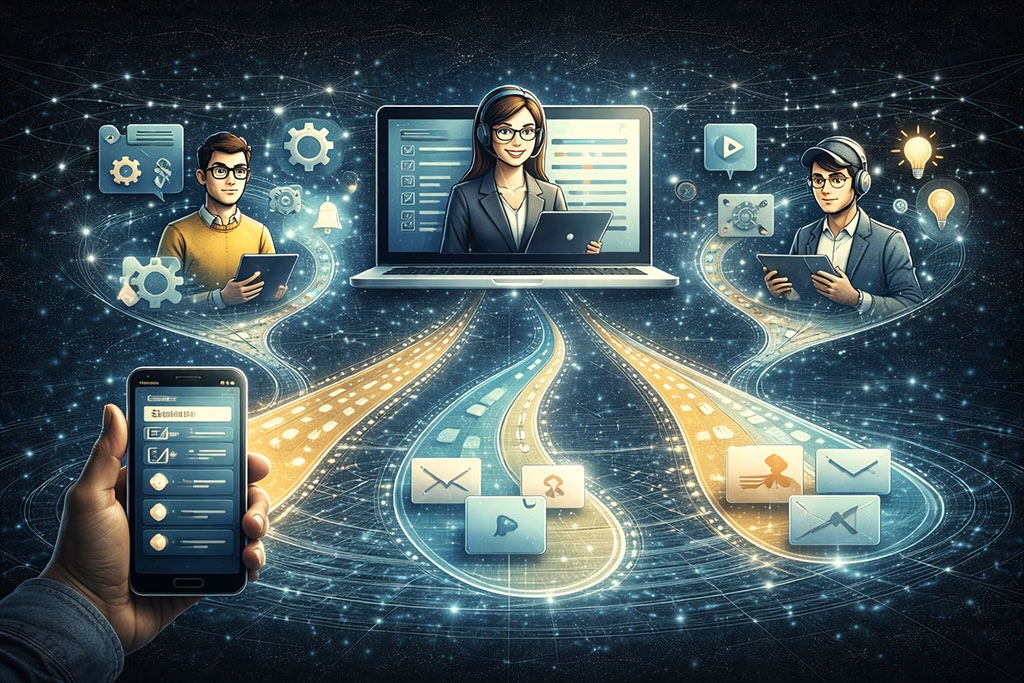
While automation provides efficiency, personalization ensures relevance. The most effective automated onboarding sequences are not one-size-fits-all. They adapt to individual user behavior, preferences, and needs, making the onboarding process more intuitive and less costly to manage.
Adapting to User Engagement
Personalized onboarding sequences dynamically respond to how a user interacts with your product. For users who are quickly grasping concepts and actively exploring features, the sequence can be streamlined, offering advanced tips and directing them towards premium functionalities. For those who are showing signs of struggle or disengagement, the sequence can provide more detailed explanations, remedial content, and direct support prompts. This adaptability ensures that every user receives the right level of guidance at the right time.
Streamlining for Quick Buyers
Some users are quick to understand and adopt. They don’t require extensive hand-holding. Personalized automation can recognize these fast-moving individuals and accelerate their onboarding. This might involve skipping introductory modules that they’ve already demonstrated proficiency in, or directly offering them advanced use cases. This speed not only satisfies their desire for efficiency but also reduces the overall time and resources required for their onboarding.
Providing Detailed Content for Explorers
| Metric | Before Automation | After Automation | Improvement | Notes |
|---|---|---|---|---|
| Customer Acquisition Cost (CAC) | 120 | 75 | 37.5% Reduction | Lower marketing and onboarding expenses |
| Onboarding Time (days) | 10 | 3 | 70% Faster | Automated sequences speed up customer activation |
| Conversion Rate (%) | 25 | 40 | 60% Increase | Improved engagement through personalized onboarding |
| Customer Retention Rate (%) | 65 | 80 | 23% Increase | Better onboarding leads to higher satisfaction |
| Support Tickets During Onboarding | 150 | 60 | 60% Reduction | Automated guidance reduces confusion |

Conversely, some users prefer a more in-depth exploration. Personalized onboarding caters to this by offering a richer tapestry of content—detailed tutorials, case studies, and best practice guides—triggered by their specific interactions. This ensures that even if a user is taking their time, they are supported with the information they need to make an informed decision about your product’s value.
Reducing Costs Over Manual Efforts
The cost savings of personalization through automation are significant. Instead of a universal approach that may over-serve some and under-serve others, personalized automation targets resources precisely where they are needed. This means less wasted time and effort on users who don’t require it, and more focused support for those who do. This targeted approach ultimately drives down the overall cost of onboarding per customer compared to a purely manual, generalized method.
Automating onboarding sequences can significantly reduce Customer Acquisition Costs (CAC) by streamlining the initial interactions with potential customers. By implementing efficient processes, businesses can ensure that new users are engaged and informed without the need for extensive manual intervention. For further insights on enhancing user engagement through optimized digital experiences, you might find this article on lightning-fast landing pages particularly useful, as it explores how speed and efficiency can impact customer retention and satisfaction.
AI-Powered Onboarding Tools: The Intelligent Assistant
The integration of Artificial Intelligence (AI) into onboarding tools marks a significant leap forward in automation. These intelligent systems can go beyond simple rule-based sequences, offering predictive insights and proactive support that further optimize the customer journey and reduce CAC.
Automating Workflows with Precision
AI-powered tools can automate complex workflows with a level of intelligence that was previously impossible. They can analyze user data to predict where a user might encounter challenges, proactively offer solutions, and even adjust the onboarding sequence in real-time based on individual progress and behavior. This level of automated precision minimizes friction points and ensures a smoother, more efficient onboarding experience.
Proactive Risk Detection
A key advantage of AI in onboarding is its ability to detect risks before they become major issues. By monitoring user activity, a system can identify patterns indicative of potential churn, such as prolonged inactivity with a critical feature or repeated errors. Once a risk is detected, the AI can trigger automated interventions, such as targeted educational content, personalized offers of support, or even alerts to a customer success manager. This proactive approach is far more cost-effective than reactively trying to salvage a customer who has already disengaged.
Seamless CRM Integration
Modern AI-powered onboarding tools are built to integrate seamlessly with your existing Customer Relationship Management (CRM) systems, such as Salesforce or HubSpot. This integration is crucial for a holistic view of the customer. When onboarding data is connected to your CRM, you gain a more comprehensive understanding of each customer’s journey, from initial lead generation to post-onboarding engagement. This interconnectedness allows for more informed decision-making, better segmentation, and a more cohesive customer experience, all of which contribute to lower CAC.
Examples of AI in Action
Tools like Rocketlane leverage AI to automate various aspects of customer onboarding. They can manage project timelines, delegate tasks, and provide automated reminders, all while learning from the data to improve future onboarding processes. This intelligent automation frees up your team from administrative burdens and allows them to focus on strategic customer interactions.
Marketing Automation’s Role in Lowering CAC
While onboarding is a distinct phase, marketing automation plays a foundational role in setting the stage and reducing the overall cost of customer acquisition. By automating various marketing touchpoints, you nurture leads effectively, minimize funnel drop-offs, and ensure that the customers you do acquire are well-qualified and ready for your product.
Minimizing Funnel Drop-Offs
The customer journey is often a long and winding road. Users may interact with your brand across multiple channels before making a decision. Marketing automation allows you to create targeted email sequences, lead nurturing campaigns, and behavior-based messaging that guides prospects through this funnel. By consistently providing relevant information and addressing potential roadblocks, you can significantly reduce the number of leads that fall out of the funnel, ensuring that more of your marketing efforts translate into potential customers.
Lead Nurturing with Precision
Automated lead nurturing allows you to deliver the right message to the right person at the right time. Based on a prospect’s interactions with your website, content, or previous communications, you can trigger a series of personalized emails and messages designed to educate them about your product and build trust. This systematic approach ensures that prospects are warmed up and better informed when they eventually engage with your sales or onboarding process.
Behavior-Based Messaging
Modern marketing automation platforms can track user behavior in real-time. This allows you to send highly personalized messages triggered by specific actions. For example, if a prospect downloads a particular whitepaper, a related email sequence can be automatically initiated. If they visit your pricing page multiple times, they might receive a targeted offer or a prompt to speak with sales. This granular level of engagement ensures that your marketing efforts are always relevant and persuasive, thereby increasing conversion rates and lowering CAC.
Benchmarking SaaS CAC
Understanding industry benchmarks is essential for evaluating your own performance. For SaaS businesses, the cost of acquiring a customer typically ranges between approximately $205 and $341. By implementing effective marketing and onboarding automation, you can aim to operate at the lower end of this spectrum, or even below it, demonstrating a significant competitive advantage in your customer acquisition strategy.
Customer Engagement Automation: Beyond Acquisition
Once a customer is acquired, the focus shifts to retention and growth. Customer engagement automation allows you to scale your efforts to keep existing customers happy and loyal, which is significantly more cost-effective than acquiring new ones.
Scalable Re-engagement and Loyalty Programs
Automated customer engagement tools enable you to build scalable re-engagement campaigns for inactive users and loyalty programs for your most valuable customers. This can include personalized email campaigns, in-app notifications, and tailored offers designed to incentivize continued usage and advocacy. By automating these processes, you can maintain ongoing relationships with your customer base without requiring a proportional increase in your customer success team’s headcount.
Stretching Budgets by Focusing on Existing Customers
Acquiring a new customer can cost five times as much as retaining an existing one. Therefore, focusing on customer engagement and loyalty through automation is a highly intelligent way to stretch your available budget. By nurturing your existing customer base, you not only reduce churn but also increase customer lifetime value (CLTV) and generate a more stable revenue stream, ultimately contributing to a lower overall CAC when viewed across the entire customer lifecycle. This strategic shift from constant acquisition to a balanced approach of acquisition and retention is a hallmark of mature and sustainable businesses.
FAQs
What is Customer Acquisition Cost (CAC)?
Customer Acquisition Cost (CAC) refers to the total expense a business incurs to acquire a new customer. This includes marketing, sales, and onboarding costs divided by the number of new customers gained during a specific period.
How can automating onboarding sequences reduce CAC?
Automating onboarding sequences streamlines the process of welcoming and educating new customers, reducing the need for manual intervention. This efficiency lowers labor costs, accelerates customer activation, and improves retention, all contributing to a reduced CAC.
What are onboarding sequences in the context of customer acquisition?
Onboarding sequences are a series of structured communications and actions designed to guide new customers through initial setup, product education, and engagement. These sequences help customers realize value quickly, increasing satisfaction and loyalty.
Which tools are commonly used to automate onboarding sequences?
Common tools for automating onboarding include customer relationship management (CRM) software, marketing automation platforms, email marketing services, and in-app messaging systems. Examples include HubSpot, Mailchimp, Intercom, and Salesforce.
What are the benefits of reducing CAC through onboarding automation?
Benefits include lower marketing and sales expenses, faster customer activation, improved customer experience, higher retention rates, and ultimately increased profitability. Automating onboarding also allows teams to focus on strategic growth activities.