


You’re operating in the subscription economy, a dynamic landscape where recurring revenue is king. To thrive, you need to cultivate loyalty, encourage upgrades, and preempt churn. Email marketing isn’t a relic of the past; it’s a foundational pillar for achieving these objectives. It offers a direct, cost-effective, and personal channel to connect with your subscribers, guiding them through their entire journey with your service. This article will explore how you can strategically leverage email marketing to fuel your subscription business’s growth.
Your subscribers aren’t a monolithic entity. They exist at various stages of their relationship with your service, and their needs and motivations change accordingly. Recognizing and segmenting these stages is crucial for crafting relevant and impactful email communications.
The Acquisition Phase: From Prospect to Paid Subscriber
The initial interaction with a potential subscriber is critical. Your email marketing here must clearly articulate value and overcome any hesitation.
Welcome Series: Setting the Stage for Success
Your welcome email is often the first direct communication a new sign-up receives after opting in or completing a trial. Make it count. This isn’t just a transactional confirmation; it’s an opportunity to onboard them effectively and set expectations.
The Crucial First Impression
Ensure your welcome email is designed to be visually appealing and easy to read on any device. Include a clear call to action, whether it’s to start their subscription, complete their profile, or explore a key feature. Reiterate the primary benefits they signed up for.
Guiding Initial Engagement
Don’t assume immediate understanding. Provide links to tutorials, FAQs, or introductory guides. This demonstrates your commitment to their success and reduces the likelihood of them feeling overwhelmed. A structured welcome series, extending over a few days, can introduce different aspects of your service progressively.
Trial Conversion Emails: Bridging the Gap from Free to Paid
For services with free trial periods, the conversion emails are paramount. You need to highlight the value they’ve experienced and create a sense of urgency or loss aversion as the trial nears its end.
Demonstrating Tangible Value
Remind them of specific features they’ve used and the benefits they’ve gained during their trial. Quantify this value if possible. For example, “You’ve saved X hours this week using our automated reporting feature.”
Addressing Objections and Offering Incentives
Anticipate common reasons for not converting. Perhaps it’s a perception of cost. Address this by emphasizing the long-term value or offering a special discount for immediate commitment. Time-sensitive offers can be highly effective here.
The Engagement Phase: Fostering Active and Satisfied Subscribers
Once a subscriber is paying, your focus shifts to ensuring they are actively using and deriving value from your service. This is where you build habits and deepen their connection.
Onboarding and Feature Adoption Emails: Maximizing Service Utilization
The onboarding process doesn’t end with the welcome series. Continuous education on how to get the most out of your service is vital for long-term retention.
Progressive Feature Discovery
Introduce advanced features gradually. Don’t bombard new subscribers with every single capability at once. Instead, focus on a few key features that drive immediate value and then introduce others as they become more comfortable.
Usage-Based Triggers
Set up emails triggered by specific usage patterns or lack thereof. If a subscriber hasn’t used a core feature, send them a reminder and guide on how to get started. Conversely, if they are heavily using a particular feature, suggest related functionalities.
Content and Value-Add Emails: Beyond the Core Offering
Your email communication should extend beyond purely functional aspects. Providing valuable content related to your niche can position you as an authority and keep subscribers engaged even when they aren’t actively using your service.
Educational Content and Best Practices
Share blog posts, case studies, webinars, or industry insights that directly benefit your subscribers’ goals. This reinforces the broader value proposition of your subscription.
Exclusive Offers and Community Building
Consider sending exclusive discounts on related products or services, early access to new features, or invitations to community events. These create a sense of belonging and privilege.
The Retention Phase: Proactively Addressing Churn and Cultivating Loyalty
Churn is the silent killer of subscription businesses. Proactive retention strategies, heavily reliant on intelligent email marketing, are essential.
Proactive Churn Prevention Emails: Identifying and Addressing Risk Factors
Recognizing the signs of potential churn and intervening before it happens is far more effective than trying to win back a lost customer.
Inactivity and Low Usage Alerts
Monitor subscriber activity. If usage drops significantly, or a subscriber hasn’t logged in for a prolonged period, trigger an email campaign to re-engage them. This might involve highlighting new features or offering support.
Negative Feedback and Support Interaction Emails
If a subscriber has recently submitted negative feedback or had multiple support interactions, a personalized follow-up email can be crucial. It shows you’re listening and committed to resolving their issues.
Customer Success and Loyalty Programs: Rewarding Long-Term Commitment
Recognizing and rewarding loyal subscribers can significantly reduce churn and encourage upgrades.
Anniversary and Milestone Emails
Celebrate subscriber anniversaries or milestones (e.g., 1 year, 5 years) with personalized messages and perhaps a small token of appreciation, such as a discount or exclusive content.
Loyalty Tier Communications
If you have a tiered loyalty program, use email to inform subscribers about their status, the benefits they are entitled to, and how they can progress to higher tiers.
The Expansion Phase: Encouraging Upgrades and Cross-Selling
Once you have a satisfied and engaged subscriber, the next logical step is to explore opportunities for them to spend more with you, either through upgrades or by purchasing additional products or services.
Upsell Campaigns: Moving Subscribers to Higher Tiers
Upselling is about encouraging subscribers to move to a more premium version of your service. This should be driven by understanding their evolving needs.
Value-Based Upsell Recommendations
Identify subscribers who are consistently using features associated with higher tiers or who would benefit significantly from advanced capabilities. Frame the upsell not as an increased cost, but as an enhancement of value.
Limited-Time Upgrade Offers
Similar to trial conversions, special offers can incentivize immediate upgrades. Highlight the added benefits and make the upgrade process seamless.
Cross-Sell Campaigns: Introducing Complementary Offerings
If you have other products or services that complement your core subscription, email marketing is an ideal way to introduce them to your existing customer base.
Targeted Recommendations Based on Usage
Analyze subscriber data to identify potential interests in other offerings. For instance, if a subscriber uses a specific feature heavily, they might be interested in a related service that builds upon it.
Bundled Offers and Package Deals
Create attractive bundles or packages that combine your core subscription with other offerings at a discounted price. This provides a clear incentive for cross-purchases.
Email marketing plays a crucial role in the growth of the subscription economy by fostering customer engagement and retention. For a deeper understanding of how lifecycle marketing triggers can enhance customer interactions and drive subscription success, you can explore the article titled “Maximizing Customer Engagement with Lifecycle Marketing Triggers” available at this link. This article delves into strategies that can help businesses effectively utilize email marketing to nurture their subscriber base and boost overall growth.
Leveraging Data for Effective Email Marketing
The power of email marketing in the subscription economy lies not just in sending emails, but in sending the right emails to the right people at the right time. This is achieved through intelligent use of data.
Data Collection and Segmentation Strategies
Gathering comprehensive data on your subscribers is the first step towards effective segmentation.
Behavioral Data: Tracking Subscriber Interactions
This includes metrics like login frequency, feature usage, content consumption, purchase history, and engagement with previous email campaigns.
Demographic and Firmographic Data: Understanding Your Audience
Collect information about your subscribers’ age, location, industry, company size, and professional roles. This context is invaluable for personalization.
Preference Data: Allowing Subscribers to Dictate Communication
Enable subscribers to specify their communication preferences, such as the frequency of emails or the types of content they wish to receive.
Personalization at Scale: Making Every Email Feel Individual
Generic emails have a limited impact. Personalization, powered by data, makes your communications relevant and engaging.
Dynamic Content Blocks: Tailoring Email Content
Use dynamic content to display different offers, product recommendations, or messaging based on subscriber segments and their individual data.
Personalized Subject Lines and Greetings: Improving Open Rates
Even small touches, like using a subscriber’s name in the subject line or greeting, can boost engagement. Advanced personalization goes deeper, referencing past interactions or specific interests.
Product Recommendations: Driving Engagement and Sales
Based on their usage patterns or purchase history, recommend relevant products, features, or content that you believe they will find valuable.
Automation and Workflow Optimization: Streamlining Your Email Efforts


Manual email campaigns are time-consuming and prone to errors. Automation is key to scaling your email marketing effectively and ensuring timely, relevant communication.
Implementing Automated Email Workflows
Identify repetitive communication tasks that can be automated.
Welcome and Onboarding Sequences: Guiding New Subscribers
As discussed, a well-structured automated welcome series is fundamental. This ensures consistent onboarding for every new subscriber.
Trial Expiry and Re-engagement Campaigns: Maximizing Conversion and Preventing Churn
Automate emails that remind users about upcoming trial expirations and provide options to subscribe. Similarly, automate re-engagement campaigns for inactive users.
Post-Purchase and Post-Cancellation Follow-ups: Maintaining Communication
Send automated thank-you emails after a purchase or cancellation. For cancellations, this could be an exit survey to gather feedback.
Trigger-Based Emails: Responding to Subscriber Actions
Triggered emails respond directly to specific subscriber actions or inactions, making them highly relevant.
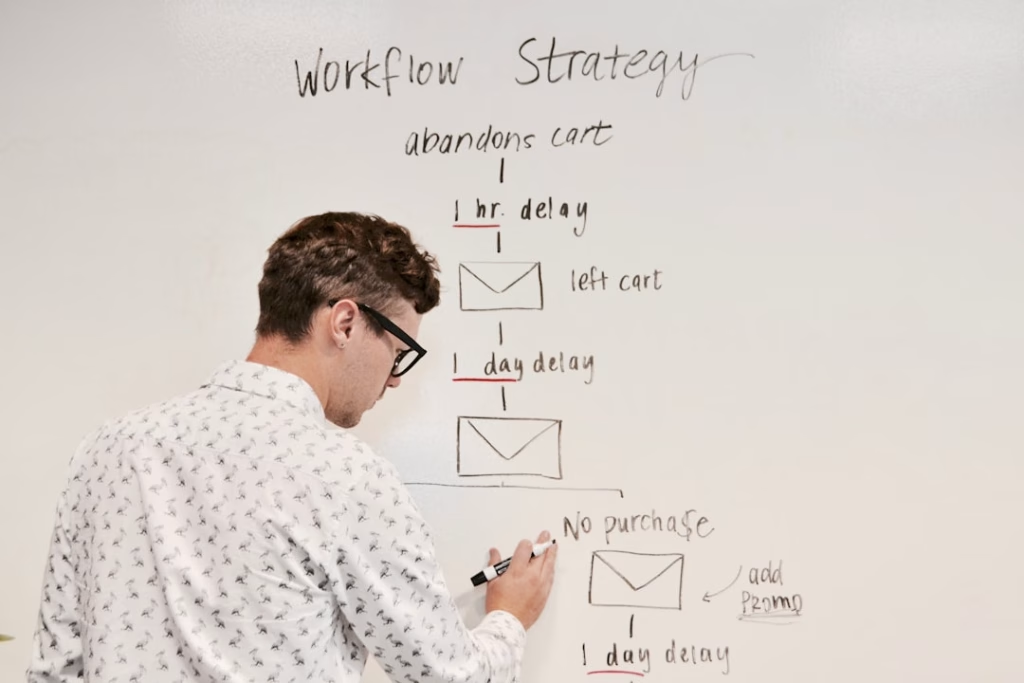
Abandoned Cart or Incomplete Onboarding Triggers
If a user starts a process but doesn’t complete it, a triggered email can prompt them to finish.
Milestone and Anniversary Triggers: Celebrating Loyalty
Automate emails that acknowledge subscriber milestones and anniversaries, fostering a sense of appreciation.
Feature Usage or Non-Usage Triggers: Driving Adoption and Preventing Churn
As mentioned, these emails can encourage the adoption of underutilized features or re-engage inactive users.
Measuring and Optimizing Your Email Campaigns

Effective email marketing is an iterative process. Continuous measurement and optimization are essential for sustained growth.
Key Performance Indicators (KPIs) for Subscription Emails
Focus on metrics that directly correlate with subscription growth and retention.
Open Rates and Click-Through Rates (CTRs): Gauging Initial Engagement
These metrics indicate how well your subject lines and preheader text are resonating and how compelling your email content is.
Conversion Rates: Measuring Actionable Outcomes
This is perhaps the most critical KPI. It measures how many recipients take a desired action (e.g., subscribe, upgrade, purchase).
Unsubscribe Rates and Bounce Rates: Indicating List Health and Relevance
High unsubscribe or bounce rates suggest your content isn’t relevant, or your list quality is poor.
Churn Rate Reduction: The Ultimate Measure of Retention Success
While not solely attributable to email, a well-executed email strategy contributes significantly to reducing churn.
A/B Testing and Experimentation: Continuously Improving Your Strategy
Don’t rely on assumptions. Test different elements of your emails to see what performs best.
Subject Lines and Preheader Text: Capturing Attention
Test variations of subject lines and preheaders to identify those that command higher open rates.
Call-to-Action (CTA) Buttons: Driving Conversions
Experiment with different CTA button text, colors, and placement to maximize click-throughs and conversions.
Email Content and Design: Enhancing Readability and Engagement
Test different copywriting approaches, image usage, and layout structures to see what resonates most with your audience.
Send Times and Frequency: Optimizing Delivery
Analyze data to determine the optimal days and times to send emails for your specific audience, and find the right balance for frequency to avoid fatigue.
Email marketing plays a crucial role in the growth of the subscription economy by fostering customer engagement and retention. For those interested in enhancing their email strategies, exploring automation can provide significant advantages. A related article discusses essential API tricks that can streamline your email marketing efforts, making it easier to manage subscriptions and improve customer interactions. You can read more about these valuable insights in this article. By leveraging these techniques, businesses can effectively boost their subscription models and drive revenue growth.
Integrating Email Marketing with Other Channels
| Metrics | Data |
|---|---|
| Increased Customer Retention | Studies show that email marketing can increase customer retention by up to 80% in the subscription economy. |
| Customer Engagement | Email marketing helps to engage subscribers with personalized content, leading to higher customer satisfaction and loyalty. |
| Upselling and Cross-selling | Email campaigns can effectively promote additional products or upgrades to existing subscribers, driving revenue growth. |
| Churn Reduction | Targeted email campaigns can help reduce subscriber churn by providing relevant offers and content to retain customers. |
| Customer Feedback | Email surveys and feedback requests can provide valuable insights for improving subscription services and customer experience. |
Email marketing shouldn’t operate in a vacuum. Its true power is unlocked when it’s integrated with your broader marketing and customer success efforts.
Cross-Channel Communication Strategies
Ensure a consistent brand experience across all touchpoints.
Social Media Integration: Amplifying Your Reach
Use email to drive social media engagement by encouraging shares, promoting social contests, or directing subscribers to follow you on social platforms. Conversely, use social media to build your email list.
In-App Messaging Synergy: Reinforcing Key Messages
Complement in-app notifications with targeted emails. If a user misses an in-app message about a new feature, an email can serve as a follow-up reminder.
Customer Support Collaboration: Creating a Unified Experience
Ensure your customer support team is aware of ongoing email campaigns, and vice versa. This prevents conflicting messages and provides a cohesive customer journey.
Building a Comprehensive Customer Journey Map
Understand how email fits into every stage of the subscriber’s interaction with your brand.
Email’s Role in Acquisition, Onboarding, Engagement, Retention, and Expansion
Map out specific email touchpoints for each stage, ensuring a logical flow and consistent reinforcement of value.
Leveraging Email for Feedback Loops: Informing Product Development and Marketing
Use email surveys and feedback requests to gather insights that can inform your product roadmap and refine your marketing strategies.
In the competitive subscription economy, email marketing is not merely a tool; it’s a strategic imperative for sustainable growth. By understanding your subscriber’s lifecycle, leveraging data for personalization, automating workflows, continuously measuring and optimizing, and integrating email with your other channels, you can build stronger relationships, reduce churn, and unlock significant expansion opportunities. Your inbox is a direct line to your subscribers; use it wisely to cultivate a thriving subscription business.
FAQs
1. What is the subscription economy?
The subscription economy refers to the business model where customers pay a recurring fee at regular intervals for access to a product or service, rather than making a one-time purchase.
2. How does email marketing support subscription economy growth?
Email marketing supports subscription economy growth by helping businesses to engage and retain subscribers, promote new products or services, and communicate the value of the subscription over time.
3. What are the benefits of using email marketing in the subscription economy?
Using email marketing in the subscription economy allows businesses to build and maintain relationships with subscribers, increase customer lifetime value, and drive recurring revenue through targeted and personalized communication.
4. How can businesses effectively use email marketing in the subscription economy?
Businesses can effectively use email marketing in the subscription economy by segmenting their subscriber lists, personalizing content, and leveraging automation to send relevant and timely messages to subscribers.
5. What are some best practices for email marketing in the subscription economy?
Best practices for email marketing in the subscription economy include providing valuable content, optimizing for mobile devices, testing and analyzing performance, and maintaining compliance with data privacy regulations such as GDPR and CAN-SPAM.