


You’re an entrepreneur. Your plate is overflowing with product development, customer service, marketing, finance, and probably a dozen other things that popped up five minutes ago. Time is a precious commodity, and every minute you spend on a task needs to yield a significant return. Email marketing, despite its enduring power, often falls into the “I’ll get to it later” pile because it feels like another thing to do. But here’s the truth: done right, email marketing isn’t just another task; it’s a powerful, scalable engine for growth that works while you’re busy with everything else.
This guide isn’t about adding more to your workload; it’s about making your existing efforts smarter and more impactful. You will learn how to build an email strategy that maximizes your reach, engages your audience, and drives sales, all without demanding a monumental chunk of your limited time. Let’s dive in.
You can have the most compelling email in the world, but if nobody’s reading it, it’s worthless. The first, and arguably most crucial, step is building a robust, engaged email list. Don’t fall for the temptation of buying lists – they’re often low quality, lead to poor deliverability, and can even get your account flagged. Focus on organic growth and attracting subscribers who genuinely want to hear from you.
Designing Effective Opt-in Forms
Your opt-in forms are the gateway to your email list. They need to be clear, compelling, and strategically placed.
Keep it Simple & Clear
Less is often more. Ask only for essential information, usually just an email address and maybe a first name for personalization. Long forms create friction and reduce completion rates. Clearly state what subscribers will receive – hints like “Get weekly insights,” “Exclusive discounts,” or “First access to new products” set expectations.
Provide an Irresistible Incentive (Lead Magnet)
Why should someone give you their email address? Because you’re offering something valuable in return. This could be an e-book, a checklist, a free template, a discount code, access to exclusive content, a mini-course, or a product sample. Make sure your lead magnet genuinely solves a problem for your target audience or provides significant value.
Strategic Placement of Forms
Don’t hide your opt-in forms. They should be visible and easily accessible.
- Website Pop-ups: Use these strategically. While some find them annoying, when timed correctly (e.g., exit-intent, after a certain time on page, or after scrolling a certain percentage), they are incredibly effective.
- Embedded Forms: Place them on relevant blog posts, your “About Us” page, contact forms, and in your website’s footer.
- Landing Pages: Create dedicated landing pages for your lead magnets. These pages minimize distractions and focus solely on collecting email addresses.
- Social Media: Promote your lead magnet on your social media channels with a clear call to action (CTA) and a link to your landing page.
Nurturing List Growth Through Content
Every piece of content you create is an opportunity to grow your list.
Blog Posts with Lead Magnet Integration
At the end of a blog post, offer a related lead magnet. For instance, if you write about “5 Tips for Social Media Marketing,” offer a “Social Media Content Calendar Template” as an opt-in. This aligns content consumption with list growth.
Webinars and Online Events
Hosting a webinar or an online Q&A session is an excellent way to capture email addresses from interested prospects. Require registration and follow up with a recording and additional resources.
Social Media Contests and Giveaways
These can generate a lot of buzz and email sign-ups. Make signing up for your email list an entry requirement, or offer bonus entries for doing so. Ensure the prize is relevant to your niche to attract qualified leads.
For busy entrepreneurs looking to enhance their email marketing strategies, the “Email Campaign Planning Guide for Busy Entrepreneurs” is an invaluable resource. To further complement your understanding of email marketing, you might find the article titled “The Ultimate Beginner’s Guide to Email Marketing in 2025” particularly helpful. This guide provides insights into the latest trends and best practices in the industry, ensuring that you stay ahead of the curve. You can read it by following this link: The Ultimate Beginner’s Guide to Email Marketing in 2025.
Automating for Efficiency: Your Secret Weapon
You don’t have an army of marketing assistants. That’s why automation is your best friend. It allows you to deliver timely, relevant messages to your subscribers without you having to lift a finger once they’re set up. This is where you reclaim your time.
Welcome Sequences: Making a Great First Impression
The moment someone signs up, they are at their most engaged. Don’t waste this opportunity. A welcome sequence is a series of automated emails designed to introduce new subscribers to your brand, build trust, and set expectations.
The Anatomy of an Effective Welcome Sequence
- Email 1: The Immediate & Grateful Welcome: Sent instantly. Thank them for signing up, deliver the lead magnet (if applicable), and briefly introduce your brand’s mission or unique selling proposition.
- Email 2: Value & Education: Sent 1-2 days later. Offer another piece of valuable content (e.g., a popular blog post, a useful tip, a short video). Start educating them about your solutions without being overly salesy.
- Email 3: Building Connection & Trust: Sent 2-3 days later. Share your brand story, a behind-the-scenes look, or a powerful customer testimonial. Humanize your brand.
- Email 4: Gentle Call to Action: Sent 2-3 days later. This is often the first time you might
introduce a product or service, but do so in a helpful way, still focusing on how it solves their problem. Offer a small discount or a free consultation.
Segmentation: Sending the Right Message to the Right Person
Sending one-size-fits-all emails is a recipe for low engagement. Segmentation allows you to divide your list into smaller, more specific groups based on shared characteristics or behaviors.
Common Segmentation Criteria
- Demographics: Location, age (if relevant).
- Purchase History: New customers, repeat buyers, customers who purchased a specific product.
- Behavioral Data: Website activity (pages visited, products viewed), email engagement (opened vs. clicked), abandoned carts.
- Lead Magnet Download: Segment based on the lead magnet they downloaded, indicating their specific interest.
- Survey Responses: If you’ve gathered information about their preferences or challenges.
Benefits of Segmentation
- Increased Open Rates: Subscribers see more relevant subject lines.
- Higher Click-Through Rates: Content aligns better with their interests.
- Improved Conversion Rates: Offers are tailored to their needs, leading to more sales.
- Reduced Unsubscribe Rates: People are less likely to leave if they’re getting valuable content.
Behavioral Automation: Responding to Actions
This is where email marketing gets really smart. Behavioral automation triggers emails based on specific actions (or inactions) taken by your subscribers.
Abandoned Cart Recovery
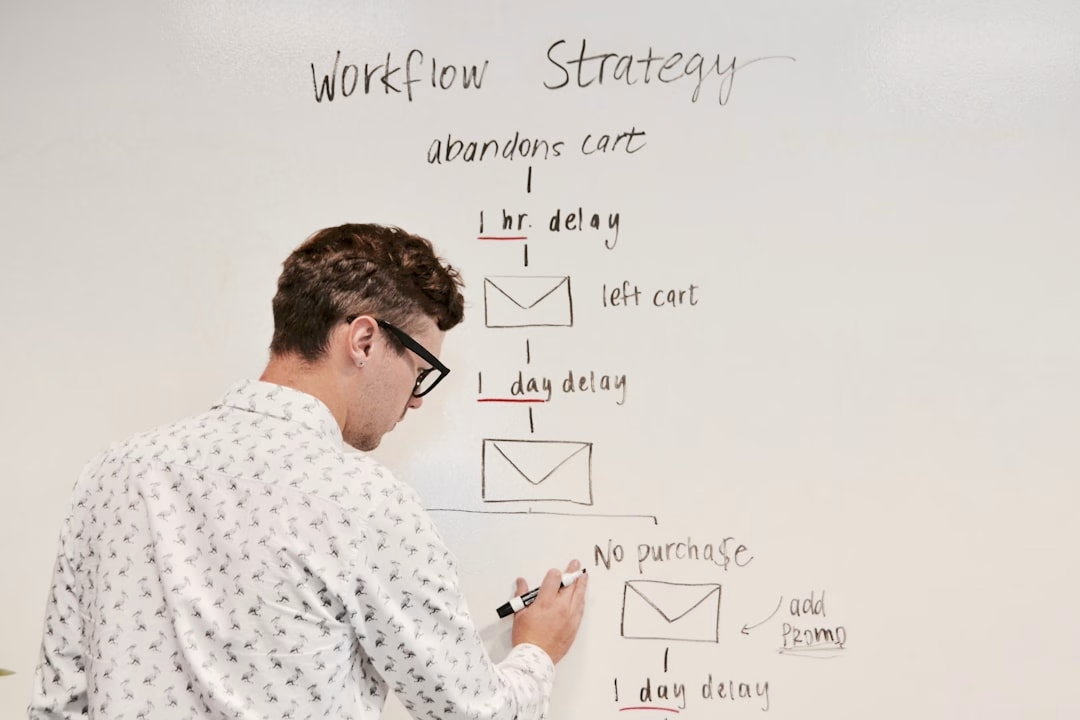
If a customer adds items to their cart but doesn’t complete the purchase, an automated email (or series of emails) can remind them, offer a small incentive, or address common concerns. This alone can recover a significant percentage of lost sales.
Post-Purchase Follow-ups
After a purchase, you can automate:
- Order Confirmation & Shipping Updates: Standard but essential.
- Product Usage Tips: Help customers get the most out of their new purchase, reducing returns and increasing satisfaction.
- Review Requests: Encourage customers to leave reviews, which builds social proof.
- Related Product Recommendations: Suggest complementary items based on their purchase.
Re-engagement Campaigns
What about subscribers who haven’t opened your emails in a while? Automate a series of emails designed to win them back with special offers or valuable content. If they still don’t engage, consider cleaning them from your list to maintain deliverability.
Crafting Compelling Content: Value Over Sales Pitches
Even with automation and segmentation, your emails won’t thrive if the content isn’t compelling. Your subscribers gave you permission to enter their inbox – don’t abuse that privilege with endless sales pitches. Focus on providing value, solving problems, and building a relationship.
Writing Irresistible Subject Lines
Your subject line is the gatekeeper. It determines whether your email gets opened or deleted.
Be Clear and Concise
Avoid ambiguity. Subscribers should have a good idea of what’s inside.
- Bad: “Important Update”
- Good: “Your Order #12345 Has Shipped!” or “New Fall Collection Inside!”
Use Emojis (Sparingly)
Relevant emojis can grab attention and convey emotion, but overdoing it can look spammy.
- Example: “🚨 Last Chance for 20% Off!” or “🌱 Grow Your Business with These Tips”
Create Urgency or Curiosity
Words like “Limited Time,” “Don’t Miss Out,” or questions can encourage opens.
- Example: “Only 24 Hours Left for Our Sale!” or “Did You Miss This Secret Tip?”
Personalize When Possible
Using the subscriber’s first name can significantly boost open rates.
- Example: “John, Your Exclusive Offer Awaits!”
Structuring Your Email for Readability
Busy entrepreneurs (and everyone else) scan emails. Make yours easy to digest at a glance.
Use Short Paragraphs and Sentences
Break up large blocks of text. A paragraph should ideally be no more than three sentences.
Incorporate Bullet Points and Numbered Lists
These make information digestible and highlight key takeaways.
Employ Varying Font Sizes and Bold Text
Use bolding to emphasize important phrases or calls to action. Don’t overdo it, or everything loses its emphasis.
Add Ample White Space
Give your content room to breathe. Don’t crowd your text and images.
Incorporating Powerful Calls to Action (CTAs)
Every email should have a purpose, and your CTA guides subscribers toward fulfilling that purpose.
Make It Obvious
Your CTA should stand out. Use contrasting buttons, bold text, and a clear link.
Use Action-Oriented Language
Instead of “Click Here,” try “Shop Now,” “Download Your Guide,” “Learn More,” “Get My Discount,” or “Book a Call.”
Create Urgency or Scarcity (When Applicable)
Phrases like “Limited Stock,” “Enroll Before [Date],” or “Claim Your Spot” can encourage immediate action.
Position Strategically
Place your CTA in multiple spots if your email is longer – typically at the top, middle, and bottom.
Maintaining Deliverability and Compliance: Stay Out of the Spam Folder
All your hard work on list building and crafting content means nothing if your emails don’t land in the inbox. Deliverability is crucial, as is adhering to anti-spam laws.
Warming Up Your IP and Domain
If you’re new to email marketing or significantly increasing your sending volume, gradually increase the number of emails you send. Sending too many emails too quickly from a new or cold IP/domain can flag you as a spammer. Start small and slowly ramp up.
Authenticating Your Emails (SPF, DKIM, DMARC)
These technical settings prove that your emails are legitimately coming from your domain and help prevent spoofing. While they sound complicated, most email service providers (ESPs) make it relatively easy to set them up with clear instructions. Don’t skip this step – it’s vital for inbox placement.
Cleaning Your Email List Regularly
High bounce rates and spam complaints damage your sender reputation.
Remove Hard Bounces
These are emails that permanently bounced (e.g., non-existent address). Your ESP usually handles this automatically, but it’s good to be aware.
Identify and Remove Inactive Subscribers
If subscribers haven’t opened or clicked your emails in 6-12 months, consider a re-engagement campaign. If they still don’t respond, remove them. They’re likely harming your deliverability and costing you money (if your ESP charges by subscriber count).
Monitor Spam Complaints
If you get too many complaints, internet service providers (ISPs) will start sending your emails directly to spam or blocking them entirely. Focus on getting genuine opt-ins and providing value to minimize complaints.
Complying with Anti-Spam Laws (CAN-SPAM, GDPR, CASL)
Ignorance is not bliss when it comes to email regulations.
Always Include an Easy Unsubscribe Link
This is legally required and helps maintain a healthy list. If someone wants to leave, let them. Forcing them to stay only increases spam complaints.
Clearly Identify Your Business
Your emails must include your physical address and clearly state who is sending the email.
Get Express Consent
Especially crucial for GDPR and CASL, you need clear, unambiguous consent before adding someone to your list. Pre-checked boxes are generally not sufficient.
For busy entrepreneurs looking to enhance their email marketing strategies, understanding the latest trends is crucial. A related article that can provide valuable insights is the one discussing the upcoming email marketing trends for 2025. This resource offers guidance on how to prepare for the future of email campaigns, ensuring that your strategies remain effective and relevant. You can read more about it in this informative article.
Analyzing and Optimizing: Continuous Improvement
| Metrics | Data |
|---|---|
| Open Rate | 25% |
| Click-through Rate | 10% |
| Conversion Rate | 5% |
| Number of Subscribers | 1000 |
| Number of Emails Sent | 5000 |
Your email campaigns aren’t static. To ensure you’re maximizing your ROI, you need to constantly monitor your performance, learn from your data, and make adjustments.
Key Metrics to Track
Your email service provider (ESP) will offer robust analytics. Focus on these core metrics:
Open Rate
The percentage of recipients who opened your email. Good indicators of subject line effectiveness and sender reputation.
- Benchmark: Varies widely by industry, but aiming for 20-30% is a generally good starting point.
Click-Through Rate (CTR)
The percentage of recipients who clicked on a link within your email. This indicates how engaging your content and CTAs are.
- Benchmark: Varies, but 2-5% is a reasonable range for many industries.
Conversion Rate
The percentage of recipients who completed a desired action after clicking (e.g., made a purchase, filled out a form). This is the ultimate measure of your email’s effectiveness at driving business goals.
Unsubscribe Rate
The percentage of recipients who opted out of your list. A high unsubscribe rate indicates content misalignment, too many emails, or a tired list.
- Benchmark: Ideally below 0.5%.
Bounce Rate
The percentage of emails that couldn’t be delivered. High bounce rates harm your sender reputation.
- Benchmark: Aim for below 2%.
A/B Testing for Better Results
Don’t guess; test! A/B testing (or split testing) involves sending two different versions of an email (e.g., different subject lines, CTA buttons, or even entire email layouts) to a small segment of your audience to see which performs better.
What to A/B Test
- Subject Lines: The most common and impactful test. Try different lengths, emojis, personalization, or urgency.
- Call to Action (CTA): Different wording, colors, sizes, or button placement.
- Send Times: Experiment with different days of the week or times of day.
- Header Images: See which visuals resonate most.
- Email Copy: Short vs. long, different headlines, or different storytelling approaches.
Interpreting Results
Your ESP will usually declare a “winner” based on opens or clicks. Apply the winning variation to the rest of your audience, and then keep testing. Small, incremental improvements compound over time.
Utilizing Feedback and Surveys
Directly ask your subscribers what they want to see more of (or less of).
Simple One-Question Surveys
Include a quick, one-click survey at the bottom of your emails (e.g., “Was this email helpful? Yes/No/Maybe”).
Longer Feedback Forms
Periodically send out a more comprehensive survey to gather insights on content preferences, frequency, and overall satisfaction. This direct feedback is invaluable for tailoring your strategy.
Conclusion
As a busy entrepreneur, your time is your most valuable asset. Email marketing, when approached strategically with a focus on automation, segmentation, and continuous optimization, becomes a powerful force multiplier for your business. You’re not just sending emails; you’re building relationships, providing value, and driving consistent growth – all while freeing yourself to tackle the myriad other challenges and opportunities that come your way. Invest in these principles, and watch your email campaigns transform from a chore into your most reliable revenue engine. Now go forth and conquer those inboxes!
FAQs
What is an email campaign?
An email campaign is a targeted marketing effort that involves sending a series of emails to a specific group of recipients with the goal of achieving a specific outcome, such as promoting a product or service, driving traffic to a website, or nurturing leads.
Why is email campaign planning important for busy entrepreneurs?
Email campaign planning is important for busy entrepreneurs because it allows them to strategically reach their target audience, build brand awareness, and drive engagement without having to spend a lot of time on day-to-day marketing activities.
What are the key components of an email campaign planning guide?
The key components of an email campaign planning guide typically include defining campaign goals, identifying the target audience, creating compelling content, designing eye-catching visuals, and setting up a schedule for sending out the emails.
How can busy entrepreneurs effectively manage their email campaigns?
Busy entrepreneurs can effectively manage their email campaigns by using email marketing software to automate the process, segmenting their email lists to send targeted messages, and analyzing campaign performance to make data-driven decisions.
What are some best practices for creating successful email campaigns?
Some best practices for creating successful email campaigns include personalizing the content, optimizing for mobile devices, including clear calls to action, testing different elements to improve performance, and complying with email marketing regulations such as GDPR and CAN-SPAM.