


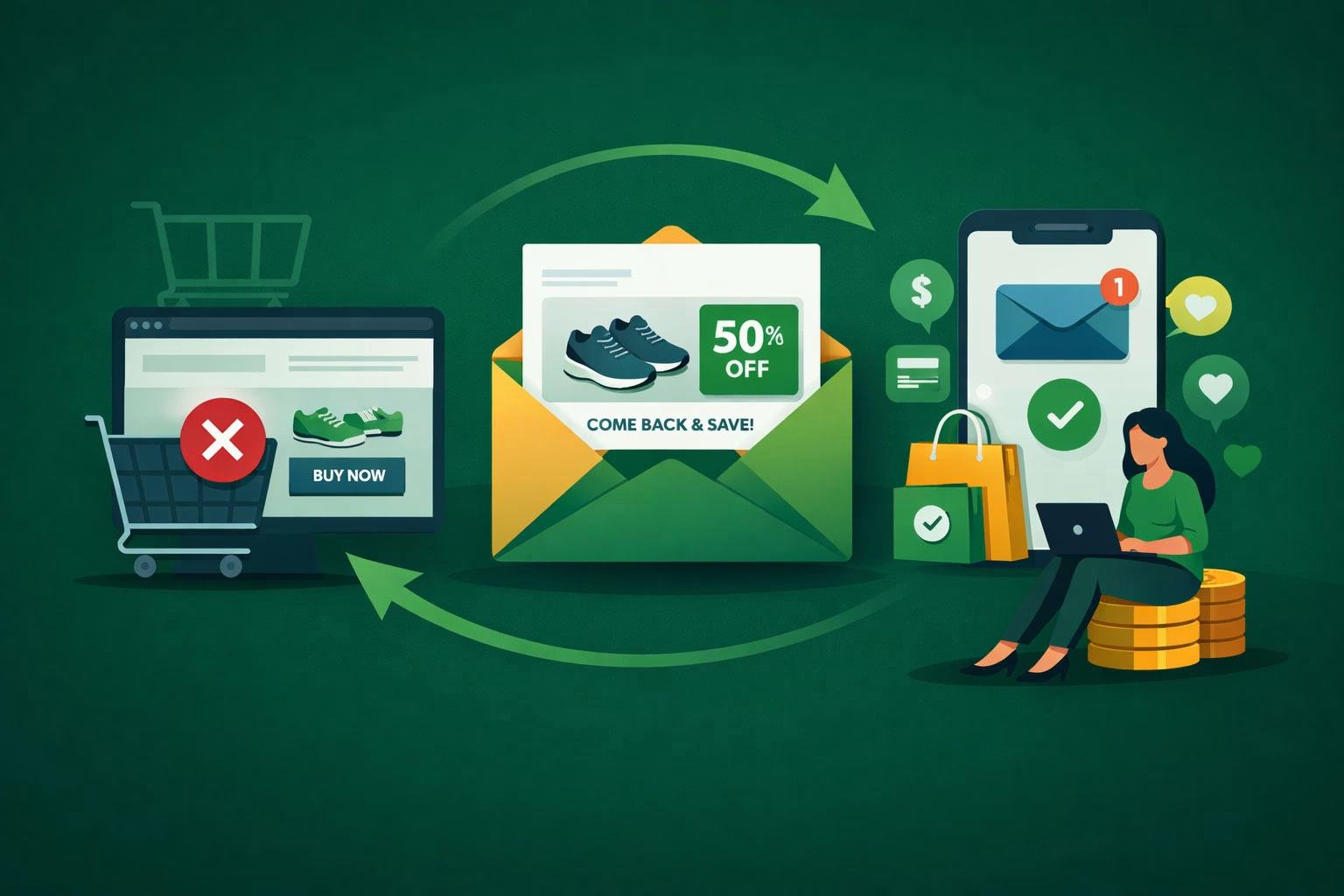
You’ve experienced it before. A potential customer visits your online store, browses through products, perhaps even adds items to their cart, and then, without completing the purchase, they vanish. This phenomenon, often termed “cart abandonment” or “browse abandonment,” represents a significant loss of potential revenue. But consider this: these individuals have already demonstrated a clear interest in your offerings. They’re not cold leads; they’re warm prospects who, for a myriad of reasons, simply didn’t cross the finish line. This is precisely where email retargeting enters the picture as a powerful recuperative strategy. You’re not chasing shadows; you’re strategically re-engaging with individuals who have already shown you a roadmap to their interest.
Before you can effectively recover lost sales, you must first understand why they occur. Think of your sales funnel as a journey, and at each stage, there are potential bottlenecks or diversions. When customers abandon their journey, they’re not necessarily rejecting your product; they might simply be encountering an obstacle.
Common Reasons for Abandonment
You might be surprised by the sheer variety of reasons for a customer to abandon a purchase. Some are easily addressed, while others might require a deeper look into your business model.
- Unexpected Costs: This is a major culprit. You’ve walked into a store, picked out an item, and then at the checkout, surprise! Shipping costs, taxes, or additional fees suddenly make the purchase less appealing. Online, this translates to hidden charges only revealed at the final stages.
- Complex Checkout Process: Imagine a brick-and-mortar store where you have to fill out extensive forms just to buy a single item. Online, a long, multi-page checkout process with too many required fields can feel like an insurmountable barrier. You want the path to purchase to be as smooth as a freshly paved road.
- Website Performance Issues: Slow loading times, broken links, or a non-responsive design on mobile devices can quickly frustrate visitors. If your website feels sluggish or unreliable, you’re essentially providing a poorly maintained vehicle for their shopping journey.
- Security Concerns: In an age of data breaches, customers are increasingly wary of sharing personal and financial information. If your website doesn’t clearly display security seals or provide a sense of trustworthiness, you’re building a house on shaky ground.
- Distractions & Time Constraints: Life happens. A phone call, an urgent email, a child’s cry – any number of external factors can pull a customer away from their purchase mid-transaction.
- Comparison Shopping: You’re not the only game in town. Many customers use shopping carts as a temporary holding pen while they compare prices, features, and reviews across different vendors.
- Lack of Trust/Uncertainty: Sometimes, a customer isn’t fully convinced about the product itself, or the reliability of your store. They might have questions that weren’t answered, or a general sense of doubt that keeps them from committing.
- Technical Glitches: While rarer, genuine technical errors can sometimes prevent a purchase from going through, leaving the customer frustrated and your sales unrecorded.
The Value of a “Warm Lead”
It’s crucial to distinguish between a cold lead and an abandoned cart prospect. A cold lead is someone who has no prior interaction with your brand. They require extensive nurturing and education. An abandoned cart prospect, however, has already undertaken a significant portion of the sales journey. They know your brand, they’ve seen your products, and critically, they’ve expressed a direct interest by adding something to their cart. Think of them as a half-baked cake; with a little more heat, they can be a delicious success.
In the realm of email marketing, understanding how to enhance engagement is crucial for recovering lost sales through effective retargeting strategies. A related article that delves into optimizing email performance is titled “Unlocking Higher Open Rates: A/B Testing Email Preheaders.” This insightful piece offers valuable techniques for improving open rates, which can significantly impact the success of your retargeting efforts. For more information, you can read the article here: Unlocking Higher Open Rates: A/B Testing Email Preheaders.
The Mechanics of Email Retargeting
Email retargeting, also known as abandoned cart emails or browse abandonment emails, is the strategic deployment of personalized email sequences to individuals who have interacted with your website but haven’t completed a desired action, typically a purchase. This isn’t about spamming; it’s about intelligent, timely communication.
Data Collection and Segmentation
The foundation of effective email retargeting lies in data. You must be able to track user behavior on your website and associate it with their email addresses.
- Website Analytics Integration: Tools like Google Analytics, combined with your e-commerce platform’s native analytics, provide a comprehensive view of user journeys. You’ll need to know which pages were visited, which products were viewed, and which items were added to the cart.
- Email Capture: This is paramount. You can’t retarget via email if you don’t have an email address. This typically happens when a user logs in, creates an account, or enters their email during the initial stages of a checkout process.
- Behavioral Triggers: The system must be set up to recognize specific actions (e.g., adding to cart, viewing a product for an extended period, reaching a certain point in the checkout) as triggers for an email sequence.
- Segmentation: Not all abandoned carts are created equal. You can segment your audience based on:
- Value of cart: High-value carts might warrant a more aggressive or personalized approach.
- Number of items: Single-item vs. multi-item carts.
- Time since abandonment: The urgency of your message might change over time.
- Specific products abandoned: Allows for highly relevant product recommendations.
- Previous purchase history: Loyal customers might respond differently than first-time visitors.
Crafting the Retargeting Sequence
A single email is often not enough. A well-designed retargeting strategy typically involves a sequence of emails, escalating in urgency and incentives. Think of it as a gentle nudge that gradually becomes more persistent.
- Email 1: The Gentle Reminder (1-3 hours after abandonment)
- Purpose: Simply remind the customer what they left behind. Assume distraction, not disinterest.
- Content: “Did you forget something?” or “Your cart is waiting!” Include images of the abandoned products, a direct link back to the cart, and perhaps a reassuring message about customer support. Avoid offering discounts immediately; you don’t want to train customers to abandon carts just to get a discount.
- Subject Line Example: “Still deciding? Your [Product Name] is waiting!” or “Oops, did you forget something?”
- Email 2: Addressing Potential Concerns (12-24 hours after abandonment)
- Purpose: Acknowledge potential hesitations. This is where you can offer solutions or social proof.
- Content: Reiterate benefits of the product, highlight customer reviews, link to FAQs, clearly state shipping policies or return policies. You might also introduce a subtle incentive without a direct discount, such as free shipping on a subsequent order.
- Subject Line Example: “Thinking about your [Product Name]? Here’s why you’ll love it.” or “Questions about your order? We’re here to help.”
- Email 3: The Incentive (24-48 hours after abandonment)
- Purpose: Provide a compelling reason to complete the purchase, often a limited-time offer.
- Content: A small discount (e.g., 10% off), free shipping, or a bonus item if they complete the purchase within a specific timeframe. Emphasize scarcity or urgency.
- Subject Line Example: “Last chance! Get [Discount]% off your cart.” or “Don’t miss out on your [Product Name] – offer expires soon!”
- Email 4: Advanced Retargeting / Product Recommendations (72+ hours later)
- Purpose: If the previous emails haven’t worked, perhaps the customer simply changed their mind about the original product. This email can pivot.
- Content: Recommend complementary products, alternative products, or bestselling items. Re-engage them with your brand, focusing on discovery rather than direct recovery.
- Subject Line Example: “Thought you might like these too…” or “Still browsing? Explore our bestsellers!”
Best Practices for Maximizing Recovery Rates
Sending emails is one thing; sending effective emails is another. You want to make every touchpoint count.
Personalization Beyond the First Name
You know what they browsed, what they added to their cart. Use this information.
- Dynamic Content: Automatically populate emails with images, product descriptions, and links to the specific items the user abandoned. You’re giving them a visual reminder of what they desired.
- Personalized Recommendations: Based on their browsing history or abandoned items, suggest related products they might also be interested in. This is like a thoughtful shop assistant, anticipating their needs.
- User Behavior-Based Messaging: Tailor the language. If they abandoned a high-value item, your message might emphasize quality and investment. If it was a common impulse purchase, a time-sensitive offer might be more effective.
Compelling Call-to-Actions (CTAs)
Your CTA is the bridge back to your conversion funnel. Make it clear and inviting.
- Prominent Placement: Ensure the CTA button is easily visible and clickable on both desktop and mobile.
- Concise and Action-Oriented Language: “Complete Your Order,” “Go to Cart,” “Shop Now,” “Claim Your Discount” are much more effective than generic phrases.
- Single Primary CTA: While you can have secondary links (e.g., to FAQs), the main purpose of the email should be clear, directing the user toward one primary action.
Timing is Everything
Delayed emails lose their potency. Conversely, very immediate emails might feel intrusive.
- Initial Email Promptness: Send the first reminder within 1-3 hours. This catches users while the experience is still fresh in their minds and before they’ve moved on to competing offers.
- Strategic Gaps: Allow enough time between subsequent emails to avoid becoming an annoyance, but not so much that the user forgets their initial interest.
- Testing and Optimization: Continuously test different timings to find what resonates best with your specific audience. What works for one demographic might not work for another.
A/B Testing and Analytics
You wouldn’t navigate an unfamiliar city without a map. Similarly, don’t implement retargeting without continuous measurement and adjustment.
- Subject Lines: Test different subject lines to optimize open rates. Do emotional appeals work better than direct questions?
- Email Content: Experiment with varying copy, imagery, and product layouts. Does a larger product image lead to higher click-throughs?
- CTA Button Design and Text: Does “Complete Purchase” outperform “Checkout Now”? Is a red button more effective than a green one?
- Offer Types: Test different discount percentages, free shipping offers, or bundle deals.
- Timing of Emails: As mentioned before, continuously refine your sending schedule.
- Conversion Metrics: Track open rates, click-through rates, conversion rates from retargeting emails, and ultimately, the revenue recovered. These metrics are your compass, guiding you in the right direction.
Beyond the Basic Cart Abandonment
Email retargeting isn’t limited to just abandoned carts. You can cleverly extend its application to other scenarios of lost interest.
Browse Abandonment Retargeting
Sometimes, a customer doesn’t even make it to the cart. They browse a product category or view a specific product multiple times but never add anything to their basket.
- Trigger: Viewing a product page X times, or spending Y minutes on a product page without adding to cart.
- Content: “Still thinking about these?” or “Did you like what you saw?” Feature the browsed products and perhaps similar recommendations.
- Purpose: Nurture interest before it fully dissipates. Think of it as a gentle hand guiding them further into your store, even if they haven’t picked anything up yet.
Post-Purchase Follow-Up (for cross-sells/up-sells)
While not strictly “lost sales,” these emails aim to prevent future lost sales by building loyalty and increasing customer lifetime value.
- Trigger: A successful purchase.
- Content: “Thank you for your order!” followed by product recommendations based on their purchase (e.g., accessories, complementary items, or next-level upgrades).
- Purpose: Encourage repeat business and demonstrate value beyond the initial transaction. You’re not just selling; you’re building a relationship.
Re-engagement Campaigns for Dormant Customers
Customers who once purchased but haven’t returned in a while can be considered a form of “lost sales” from your recurring revenue.
- Trigger: No purchase activity for X months.
- Content: “We miss you!” “Here’s what’s new,” or a special discount to entice them back.
- Purpose: Revive previous customer relationships and prevent them from migrating to competitors. You’re reminding them why they chose you in the first place.
Email retargeting strategies are essential for recovering lost sales, and understanding the importance of maintaining a clean email list can significantly enhance these efforts. For marketers looking to optimize their campaigns, exploring the insights in the article about the value of a clean email list can provide valuable guidance. By ensuring that your email list is well-maintained, you can improve engagement rates and ultimately drive more conversions. To learn more about this crucial aspect of email marketing, check out the article on the value of a clean email list.
The Ethical Considerations and Compliance
| Strategy | Open Rate (%) | Click-Through Rate (CTR) (%) | Conversion Rate (%) | Average Recovery Time (hours) |
|---|---|---|---|---|
| Personalized Product Recommendations | 45 | 18 | 12 | 24 |
| Time-Sensitive Discounts | 50 | 22 | 15 | 12 |
| Cart Abandonment Reminder | 40 | 20 | 14 | 6 |
| Social Proof & Reviews | 38 | 16 | 10 | 18 |
| Multi-Channel Follow-Up | 42 | 19 | 13 | 20 |
While effective, email retargeting must be handled with care and respect for privacy regulations. You’re walking a fine line between helpful reminder and intrusive annoyance.
GDPR and CCPA Compliance
You must ensure that your data collection and email practices adhere to regulations like the General Data Protection Regulation (GDPR) in Europe and the California Consumer Privacy Act (CCPA) in the United States.
- Explicit Consent: Ensure you have obtained proper consent to send marketing emails. Opt-in mechanisms should be clear and unambiguous.
- Transparency: Clearly state your privacy policy and how customer data is used.
- Right to Opt-Out: Every email must include an easily accessible unsubscribe link. Failure to provide this is not only illegal but also a surefire way to alienate customers.
Frequency and Relevance
Over-sending or sending irrelevant emails can quickly lead to unsubscribes and negative brand perception.
- Cap Your Campaigns: Set limits on how many retargeting emails a single user can receive within a given timeframe.
- Contextual Relevance: Always strive for emails that are relevant to the user’s recent interactions with your brand. A finely tuned retargeting strategy is like a skilled angler, knowing exactly when and how to cast the line.
In conclusion, abandoned carts and browses aren’t simply lost opportunities; they are incredibly valuable signals of customer intent. By implementing a sophisticated and well-optimized email retargeting strategy, you can transform these near-misses into completed transactions. You’re not just recovering sales; you’re nurturing relationships, demonstrating attentiveness, and ultimately, building a more resilient and profitable business. This isn’t magic; it’s the strategic application of communication, informed by data, to gently guide your interested prospects back to the finish line.
FAQs
What is email retargeting?
Email retargeting is a marketing strategy that involves sending targeted emails to potential customers who have previously interacted with a brand but did not complete a purchase. The goal is to re-engage these users and encourage them to finalize their transactions.
How does email retargeting help recover lost sales?
Email retargeting helps recover lost sales by reminding customers of products they showed interest in, offering personalized incentives, and addressing potential objections. This targeted approach increases the likelihood of converting abandoned carts or browsing sessions into completed purchases.
What are common types of emails used in retargeting campaigns?
Common types of retargeting emails include cart abandonment emails, browse abandonment emails, personalized product recommendations, special discount offers, and follow-up emails that provide additional information or customer support.
How can businesses personalize email retargeting campaigns?
Businesses can personalize email retargeting campaigns by using customer data such as browsing history, past purchases, and demographic information to tailor email content. Personalization can include addressing recipients by name, recommending relevant products, and sending time-sensitive offers based on user behavior.
What metrics should be tracked to measure the success of email retargeting?
Key metrics to track include open rates, click-through rates, conversion rates, revenue generated from retargeting emails, and the overall return on investment (ROI). Monitoring these metrics helps businesses optimize their email retargeting strategies for better performance.